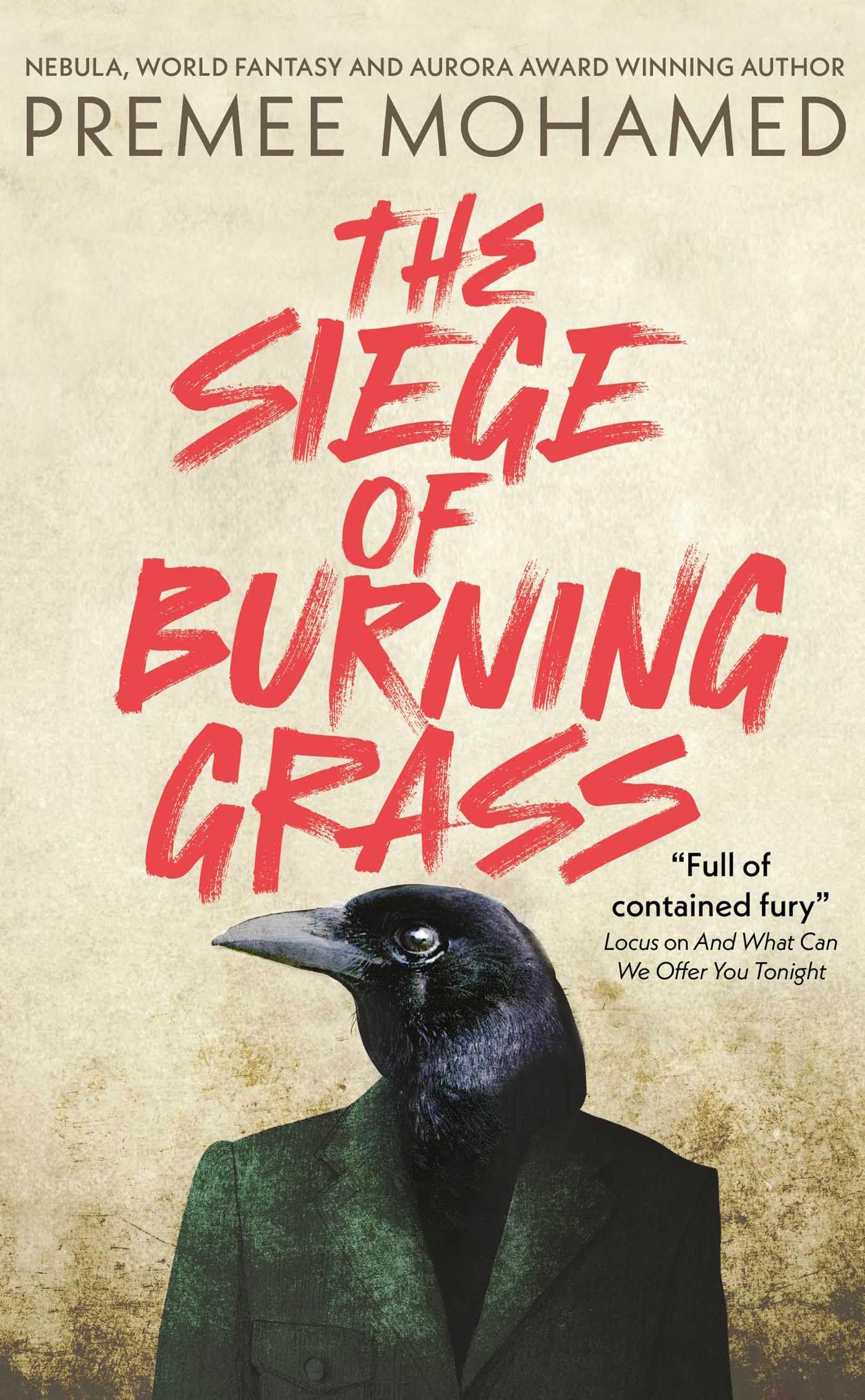
There’s a great scene from M*A*S*H* about war being worse than hell, because at least everyone in hell has done something to earn that punishment whereas war tends to reserve its greatest harm on those whose only crime was living in the line of fire. I thought about that a lot while reading Premee Mohamed’s The Siege of Burning Grass, in which a pacifist and a zealot have to work together to end a decades-long war.
Alefret, a bear of a man whose pacifism has earned him the title of traitor to the Varkal nation, would be in agony even if the military wasn’t holding and torturing him, thanks to a bit of friendly fire that resulted in the loss of one leg. His refusal to denounce his beliefs or name others in his organization only enrage his captors, including one particularly zealous soldier, Qhudhur. But Varkal is getting desperate and Alefret is “asked” to go on a mission to infiltrate a floating enemy city. After being assured his involvement would not result in the death of anyone on either side, Alefret reluctantly agrees. He wishes he hadn’t when he learns the only other member of the mission is Qhudhur.
Things go even worse than expected as Alefret and Qhudhur hit the road. Qhudhur is a propaganda recitation machine; the time he doesn’t spend reciting the nation’s militant talking points he uses to mock and threaten Alefret or attack any other living thing they come across. Alefret hopes for death, but the closer they get to the city and the more of their own military they see, the more he sees an opportunity to rekindle his roots as a teacher to the frighteningly young soldiers surrounding them—and to maybe make a peaceful difference to this bitter war, after all. Whether or not his dedication to pacifism can make it through that end intact, however, is another question entirely.
Siege is a good read, a compelling read, but it’s not an easy read. Mohamed’s lyrical prose makes the events beautiful, but intentionally doesn’t blunt them. Alefret’s circumstances are bleak at the jump and they only get worse as he sets out with Qhudhur. There’s plenty of implied violence in this road trip from hell, but there’s plenty of it on the page, too, as Qhudhur beats Alefret and murders people in front of him. Somehow, that kind of violence is expected, and isn’t as bracing as the verbal and emotional abuse Alefret endures as berates him for his disability, his beliefs, and the body he inhabits, among other things. Alefret’s pacifism, obviously, is tested during the course of the journey (to say nothing of the reader’s desire to throttle Qhudhur), and while he’s a sympathetic and relatable character, his circumstances also make him an angry one. Rather than the whole thing feeling like a didactic trial of Alefret’s beliefs, Mohamed manages to keep all of it within the realm of reality; you can imagine a road trip with any number of real-life home-grown extremists unfolding similarly.
Being so reality-adjacent in its rhetoric makes Siege difficult to read at some points, too. I’ve been turning this book over in my mind in the aftermath of the U.S. presidential elections, as a number of people whose beliefs should be on the very fringes of social unacceptability find new boldness and validation in, as I imagine they see it, the tide of power turning their way. Considering present and growing conflicts globally, it’s clear that Qhudhur is far from exceptional. His run-of-the-mill keg-standing of the Kool-Aid makes him that much more frightening, and pathetic, as a result.
It would be nice to say that I got to the end of The Siege of Burning Grass with a new conviction for pacifism, or hope in how even the most embittered conflicts can end. I suspect that’s a far more simplistic story than Mohamed is ever inclined to tell. When the dust settles and the blood has more or less stopped dripping, there’s little absolution—but there is clarity for Alefret, in his creed, and humility and deeper understanding in how it weathers temptation. For the reader, it is a reminder of the after that can come even after years upon years of conflict–and, perhaps more importantly, that there is, can, will be an after to work towards.
 Ring Reads