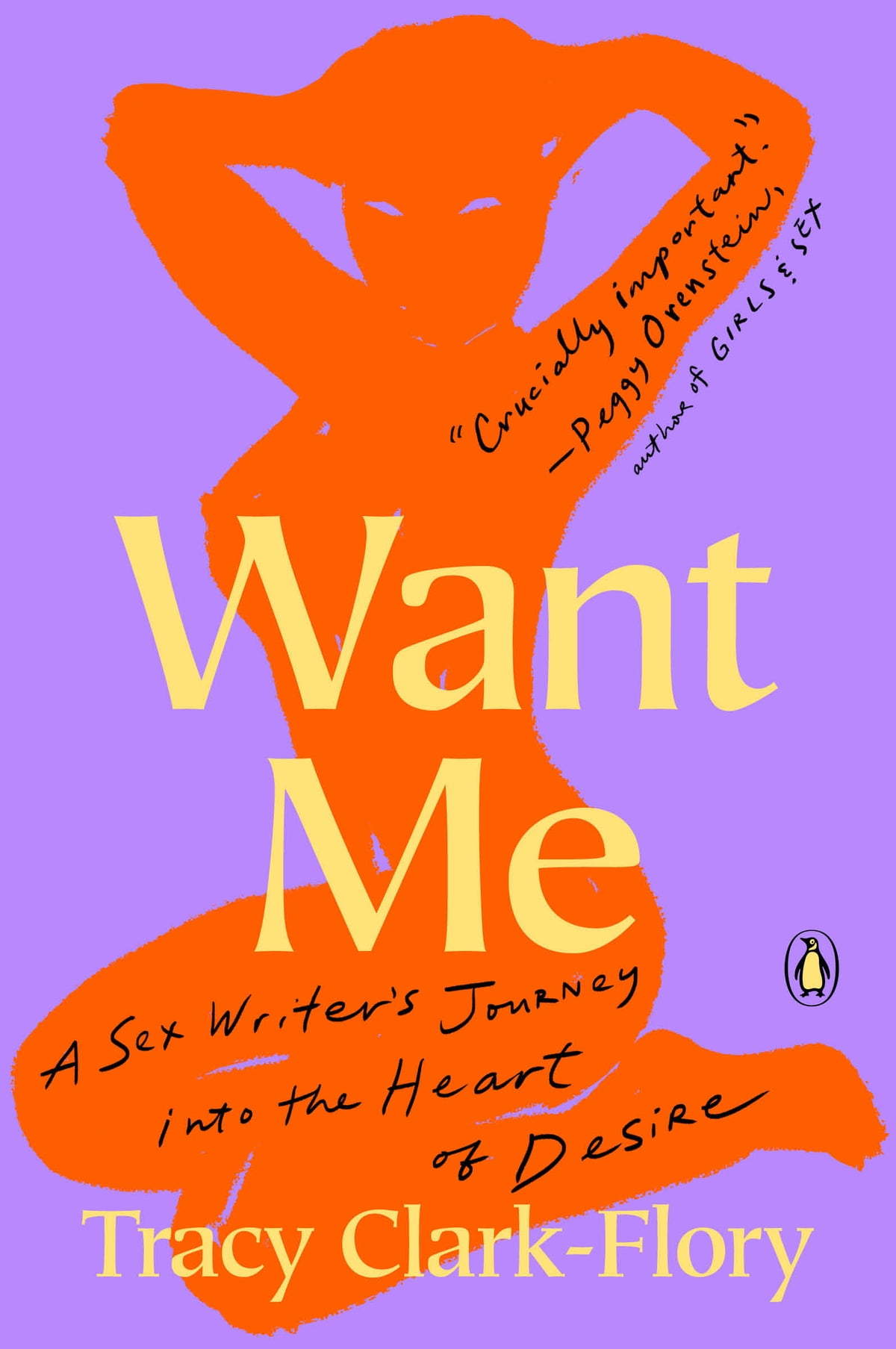
I come from a family of readers, so I often talk about what I’m reading with different family members. But it’s important to know the limits of your audience. My mother, for example, doesn’t see the purpose in anything that would put a book above a PG movie rating. Obviously, I haven’t told her about Want Me: A Sex Writer’s Journey into the Heart of Desire. At the same time, prolific sex writer Tracy Clark-Foley’s book is utterly untitillating, despite a parade of body parts, sex toys, or sex-driven entertainment described inside. Instead, what we get is a frank and unflinching look at the ripple-effect media, particularly porn and other sex-geared entertainment, has on how people conduct themselves in real-world relationships.
Clark-Foley puts her own experiences in conversation with the feminist writers she seeks out along the way, which had the side benefit of giving me a better understanding of feminist theory than I got in the course I took about it in grad school (though, admittedly, the bar is low). Her career has given her greater opportunity to ask questions and seek answers in the realms of dating and sex, but she wisely chooses to keep the focus on her as an example as a larger trend rather than a lens through which to make sweeping generalizations.
Clark-Foley’s writing primarily treads along binary gender lines, and much of this work feels like a look back from an older, wiser position. But there are moments that seem to have struck her by surprise, primarily in how her exploration of female desire, real or imagined, accidentally uncovered a glimpse of what the male version of this book might be. The same cultural expectations that demanded her to perform in a certain way also demanded her partners expect that performance from her—both partners in the tango taking cues from anyone but themselves.
Late in Want Me, Clark-Foley writes, “I sometimes wondered what my desires might look like if I wasn’t such a product of our culture.” While that’s not the main point of her exploration or the arguments she makes along the way, it’s in many ways the grand-question of everything else she asks. Why did she feel so compelled to mirror women in porn even before she was in the throes of puberty? How might her relationships have been different if she hadn’t felt such a drive to perform, not just sexually but romantically, as well? How might her relationships have been different if her partners hadn’t been expecting her to perform in that way, too? It’s a barrier to inauthenticity that she doesn’t condemn, but does recognize as a powerful force that didn’t stop affecting her even after marriage and childbirth.
Still, Clark-Foley never raises a banner against porn or sexual experimentation, though she does make sure to include pervasive sexual violence, politicized reproductive rights, poor sex education, and insidious double standards between genders as co-defendants in her case. Rather, she looks back on herself in that mire, and at those currently in and yet to cross into it, with almost defensive tenderness. “I wish better for that girl [that I was]. Of course I do. I also know that at each step of the way, she was doing what worked for her at that moment, in that context.” She’s not always right, and she doesn’t always defend her actions, but the acceptance softens the blows of those memories. It’s a kindness toward a former self I wish I could muster for any of my cringes of yesteryear.
That kindness is also padding against frequently difficult subject material. I mentioned that this isn’t a titillating read, but that doesn’t mean that it’s an easy one. There’s plenty of explicit language and themes, obviously, but the hardest parts to read were Clark-Foley’s descriptions of how she felt she needed to perform, and why she asked for or put herself in a position to receive certain sex acts. Her mother dies of cancer during the course of the book, and Clark-Foley’s grief, as well as the discovery of her mother’s predilection in younger years, can be tough to read. Yet the rawness of her recollection was as compelling as it was hard to read, turning Want Me into a thought-provoking exploration into a single person’s experience that looks much too familiar for even someone far outside of her singular experience.
 Ring Reads