Those who don’t study history, it’s said, are doomed to repeat it. It’s an adage I couldn’t stop thinking about while reading Timothy Egan’s latest history, A Fever in the Heartland: The Ku Klux Klan’s Plot to Take Over America, and the Woman Who Stopped Them. The events in the book might have taken place a full century ago, but there was plenty that resonated nice and loud to the present day.
Along with bootlegged liquor, jazz, flapper dresses, and generally glamourous debauchery, the Roaring Twenties were fabulous years for the Ku Klux Klan. The hate group might be thought of as a blight of once-Confederate states, but Egan’s narrative defends the South on that front: the hottest of hotbeds for bigots were in the Midwest. Indiana’s Klan flourished under the charismatic leadership of D.C. Stephenson. That he had drifted up from Texas, leaving multiple wives in multiple states, had a habit of brutalizing women, and was an alcoholic in the organization that preached family values and spearheaded Prohibition were immaterial to his gathering and dissemination of power. Under his leadership, the Klan filled municipal seats, staffed police stations, and unofficially dictated state legislation and other affairs.
Meanwhile, Madge Oberholtzer was a 28-year-old state capital staffer who met Stephenson at an inaugural ball and, despite not being romantically interested in him, found him charming—until he kidnapped, drugged, and assaulted her. Wounded and under armed guard in a hotel room far from home, Oberholtzer desperately attempts to take her life to save her family from the shame of her rape. The attempt, along with infected wounds from Stephenson’s attack, eventually do end her life. But before she passes, Oberholtzer is able to record her account of events. That statement is her voice from the grave as one of the few non-Klan public officials in town brings murder and kidnapping charges against the Grand Dragon of Indiana in a trial for the ages.
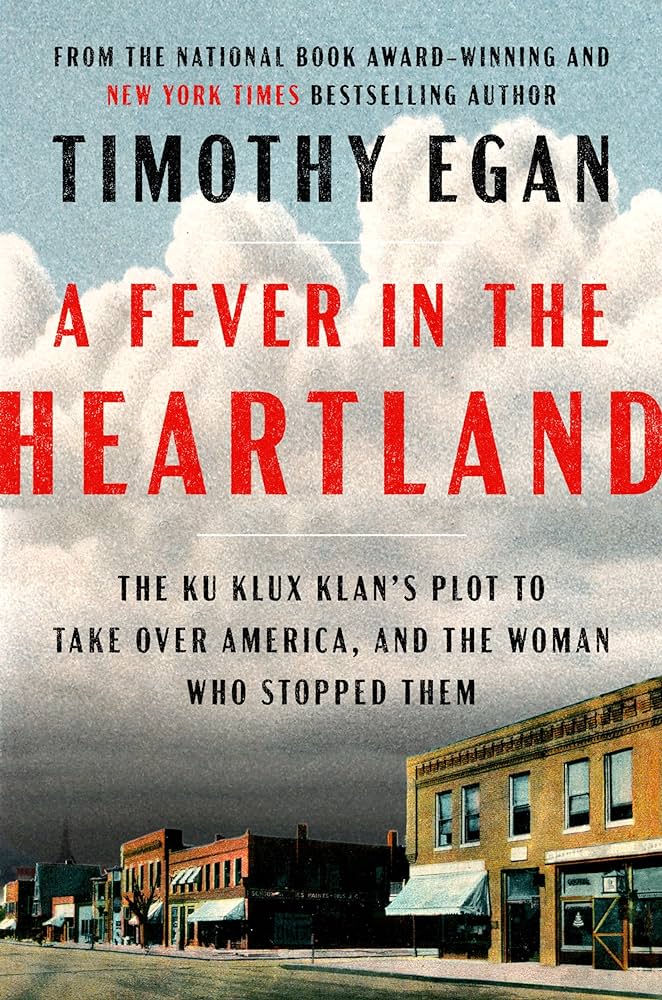
If you’re looking for a measured account of this era and struggles over racial, religious, and cultural equality from both sides, this ain’t it. Egan’s distain for the Klan is apparent in the group’s every move and attitude. After a “successful” election for the Klan, for example, Egan writes, “Nationwide, when members of the secretive society opened their daily newspaper they found that their prayers to a discriminatory God had been answered.” But this isn’t some protracted opinion piece; the hefty notes section is proof of Egan’s research. His derisive tone for this once-majority is refreshing in an era obsessed with telling “both sides,” even when one side is completely off its rocker.
While these events took place a solid century ago, and Egan feels more than comfortable to take a shot at the Klan at every (well-earned) opportunity, there are far too many familiar themes for comfort. From the governor of Georgia calling for “a wall of steel, a wall as high as heaven” to keep out immigrants at a 1924 Klan rally, to Congress’ inability to get the votes to pass an anti-lynching law (which only happened in 2022), to pushing laws to prohibit teaching evolution in favor of the Bible’s account of creation, to this cute little quote about the Klan’s ultimate goals to grow nationwide and into the White House: “it was an absurd idea only to those who believed that a vibrant young democracy could never be given over to a gifted charlatan”—all of it seemed a little more familiar than a book of history ought to. It’s easy to look back at a group that started with the disenfranchisement of one group and then widening its scope until only one homogenous group remains acceptable and see the evil, but when it comes back wearing a hat and a fake mustache, suddenly it’s a respectable political movement again.
Again, Egan’s take has no patience for the ideological strong-arming. In detailing this little-known series of events, Fever provides a reminder that our fraught political landscape is nothing new, nor is a swift wave that threatens to sweep society back a few decades. Encouragingly, if this past event is a strong enough model to the present, the small but determined actions of resistance can prevail in the end.
One quibble: The subtitle to Fever is a nice tribute to Oberholtzer , whom Egan argues is an unsung hero of the eventual decline of the Klan. It’s a compelling argument, and I can’t disagree. But suggesting she’s a force that resisted the tide of hate is a little misleading. Oberholtzer was kidnapped, brutalized, and subsequently threatened to the point she felt death was preferable to the life that awaited her courtesy of Stephenson. She died in unimaginable agony, and her character was sullied after her death. As gratifying as it is for her words to hold such power, it feels like a poor consolation prize for her stolen life.
 Ring Reads