I once saw Mark Hamill talking about the creative choice he made in making Luke Skywalker so whiney in Star Wars: A New Hope. George Lucas had explained that they hoped to make a full trilogy, he said, but the first one had to do well enough in theaters to make that happen. Knowing he might only have one film as Luke Skywalker, Hamill made the character extra whiney at the start so Luke could have a full character arc by the end of the movie.
As far as I know, Emily Tesh’s Some Desperate Glory won’t have a sequel (nor is there a need for one). But one installment is all her main character needs to have a sizeable character arc. Besides the glitzy sci-fi backdrop, there’s plenty of substance, as well.
Kyr is top of the top, best of the best. Kyr makes type A personalities look lazy. She’s just seventeen, but she’s sure all this effort will pay off when she receives her assignment for how she’ll serve Gaea, the space station holding last free holdout of humanity after the destruction of the Earth, for the rest of her life. While she ends up profoundly disappointed in her own assignment, far worse is where her brother, Mags, is assigned: a top-secret team that only gets deployed to missions of certain death. By the time she finds this out, via strong-arming Mags’ tech-genius friend Avi, Mags has already left the station. Kyr, using all the foresight her underdeveloped prefrontal cortex affords her, steals an alien ship and brings the alien, Yiso, and Avi along for the ride. Their travels take them to Mags, but also to Kyr’s supposedly traitorous sister. Kyr, impervious to any suggestion that the indoctrination she’s gulped down her whole life isn’t true, decides to take on Mags’ suicide mission for herself. Doing so, however, sets off a chain reaction of events that result in death from murder, genocide, and suicide.
A powerful AI/reality engine gives Kyr a second chance to stop those deaths, and Kyr eagerly accepts. The version of Gaea she reappears on, however, is vastly different than the one she left. Far from being the oppressive and militaristic enclave of humanity’s holdouts, it’s the center of humanity as the peacekeepers of the universe. This comparative liberty of movement and thought would almost overwhelm Kyr even if she weren’t still reeling from all the spilt blood from her other timeline. As it is, it takes this reality’s Yiso and Mags to find and recruit her to keep the very genocide she came to stop from happening. But a person can only learn so fast, and Kyr is quickly learning how much she has to un-learn before she can succeed.
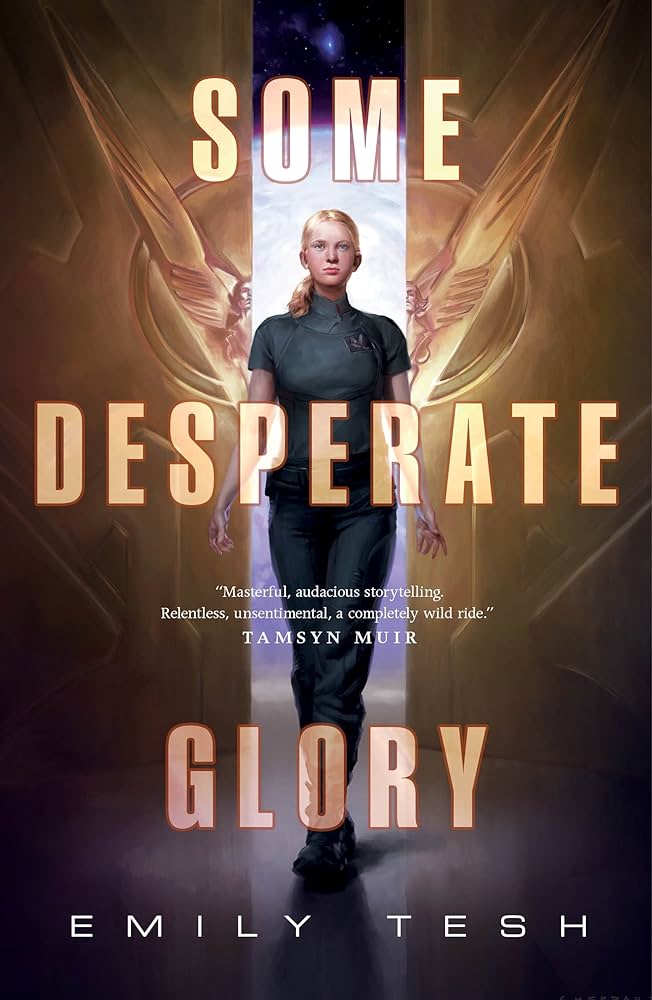
There’s a whole lot to love in Some Desperate Glory. Early on, Kyr is so focused and abrasive that it’s obvious some big character arc is coming, and Tesh delivers, allowing Kyr to grow beyond the constraints of her upbringing. Enough seeds of that arc are planted early enough for the reader to see through the cracks long before Kyr notices them appearing. This doesn’t mean that Kyr is never a difficult character to root for, or that she is, by the end, warm or bubbly. Rather, it feels like end-of-book Kyr understands she is only at the beginning of a long journey of understanding and growth. It’s the kind of humility you get when you learn how much you don’t know, and it’s nice to see how well that’s represented with Kyr and those who surround her throughout the book.
Some Desperate Glory is marketed as an adult sci-fi novel, though the tone and scope seem more appropriate for an upper-teen audience. I suspect that it was bumped into the adult category due to subject matter, which would probably be a bit much for younger or even many middle teens. In addition to the violence and death, there’s a strong culture of sexism aboard Gaea, and that’s not even mentioning the sexual assault and forced birth that is woven into the very fabric of Kyr’s world.
I’ve heard some criticism about how deeply Tesh explores some of the many difficult issues introduced here, and they’re valid concerns. Some Desperate Glory is an ambitious story in a lot of ways, and doesn’t have time to explore each issue fully. For the most part, Tesh knows this, and shows that her characters are only just starting to grapple with the long process of un- and re-learning. Especially for a younger audience, though, it makes for a solid introduction into heavy topics like sexual coercion, homogeneity, reciprocal violence, colonialism, and how deeply early lessons can root even when the person they belong to has learned differently. (Yet another reason why publishers and booksellers should recognize, and embrace, a “new adult” genre.) There’s a lot of applicable stuff here, even if it is wrapped in the glitz of spaceships and aliens and timey-wimey stuff.
I have a few personal quibbles with Some Desperate Glory, but even at the farthest reaches of those quibbles, its virtues readily outweigh them, and is a solid addition to modern science fiction—especially for younger fans. It’s a place to start thinking, rather than receive answers, about how the virtues and mistakes of Gaea have echoes in reality.
 Ring Reads