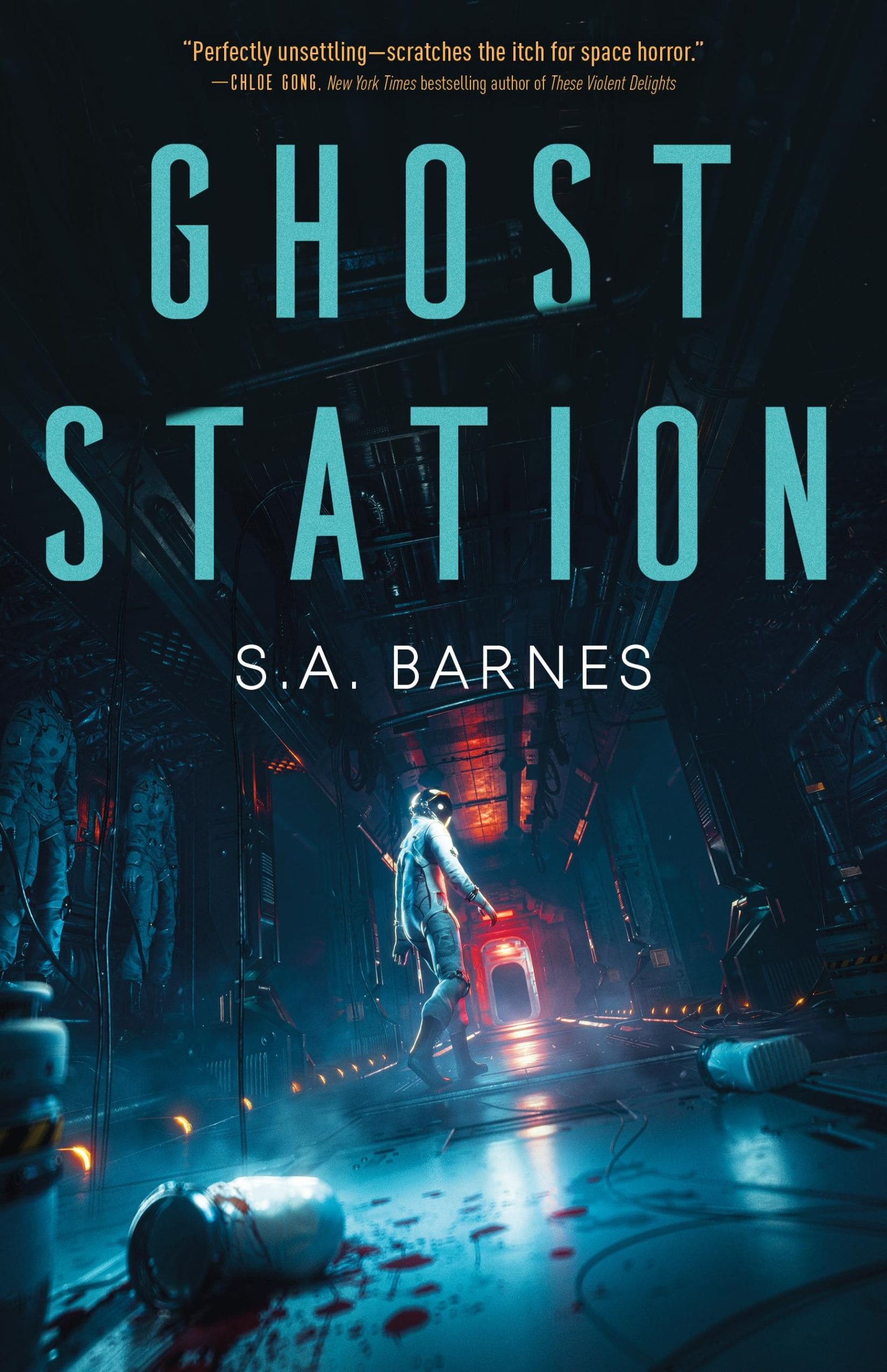
In space, as they say, no one can hear you scream. This is far from true in S.A. Barnes’ Ghost Station, where the past haunts the present in more than one way—and there are plenty of screams to cut through the silence.
Ophelia Bray might have come from one of the wealthiest families in the Earth commonwealth, but her lineage is far more liability than advantage as she tries to re-establish herself as a psychologist after a patient’s death. Her research focuses on Eckhart-Reiser syndrome (ERS), a pattern of psychological deterioration that includes paranoia and eventual violence—the most extreme case of which resulted in the slaughter of twenty-nine people on a remote outpost. Hoping to make a new start of things, she takes a new position with a small team tasked with claiming an uninhabited planet for their parent company.
Things start rough and only get worse from there. Before Ophelia’s arrival, the team loses a member—possibly to ERS—but won’t talk about it, and resents when Ophelia asks about her, or anything else for that matter. There’s something hinky about the abandoned planetary station they hole up in to start the planet-claiming, and several inconsistencies in the accounts of previous teams who have tried to claim the planet. Ophelia’s own trauma starts whispering even as the crew members begin behaving increasingly erratically. And then, just as she thinks things can’t get worse, one crew member is found dead—and it looks like it was murder. It would be the perfect setup for a closed-door mystery if it weren’t for the whole possible extraterrestrials thing. And if Ophelia thought the team’s collective mental health was bad before, well, things are about to get a lot worse.

Ghost Station is rife with creepy elements right out the gate: an abandoned building in a foreboding place surrounded by an unending store; a cast of characters filled with equal amounts trauma and secrets; unseen but probable violent deaths in the not-too-distant past; and shady motivations. Barnes makes the most of them, but also, frankly, digs deeper than necessary. The result is a far more interesting book than Ghost Station could have been, one that interweaves ghosts of varying levels of literalism. It clocks in at over 500 pages, but they flew by as I raced to see what would happen next. Including late at night, which I’m happy to report wasn’t one of my best ideas.
That the environmental and psychological horror are equally well drawn is a victory for Barnes. While it’s familiar territory from Barnes’ previous book, Dead Silence, as is the presence of corrupt megacorporations with virtually endless power, but Ghost Station, if anything, shows more mastery of that territory. As in Dead Silence, the characters, including our main character, aren’t necessarily “likable” or reliable, but are increasingly nuanced, and their missteps and anxieties feel realistic against the shadowy backdrop they’ve been given. Ophelia in particular is difficult to love, weighed down by baggage and her own strict requirements for success; through the unfolding horror, she’s forced to work through her scars in a way I found both authentic and heartening in a way I rarely see in fiction.
For all its virtues, Ghost Station wasn’t perfect. A little too much allusion to Ophelia’s past in the beginning made the first chapter or two more sluggish than the rest, and a detail or two was wrapped up a little conveniently—or hand-waved away—in the final pages. Yet between those minor missteps, Barnes crafts a taut horror with radically flawed characters that combine to make a satisfying horror of both the past and the unknown.
 Ring Reads