
If the idea behind trigger warnings is to give a head’s up about difficult topics so readers who have difficulty with these topics aren’t caught unaware and experience a resurgence of struggles, trauma, and other hard emotions, Juliet the Maniac arguably doesn’t need any—potentially triggering material (self harm) appears practically on page one.
The message of author Juliet Escoria’s starting point is clear: buckle up, buttercup.
When Escoria’s narrator of this lightly fictionalized memoir/work of autofiction appears in that self-harm scene, she’s a witness to her friend’s clumsy attempt at self-harm, offering tips from her own wealth of experience. By and large, this Juliet is a smart, driven incoming high school freshman, determined to shine in high school to launch herself into a brilliant adulthood. The scars her friend spots are the only outward manifestation of a darkness growing within, and that would start overrunning her within months.
As that darkness grows, Juliet starts hearing and seeing things that may or may not be there, and the drugs and drinking with her new high school friends likely only accelerate her spiral that lands her in a hospital, and then a mental hospital, twice. Her parents take her to therapy. They put her in a different school, try enforcing boundaries, try coddling her, try thing after thing until they come upon a camp in the mountains that promises to help turn around troubled youth. But even there, miles from civilization, nothing can get Juliet away from the thing causing her problems: herself.
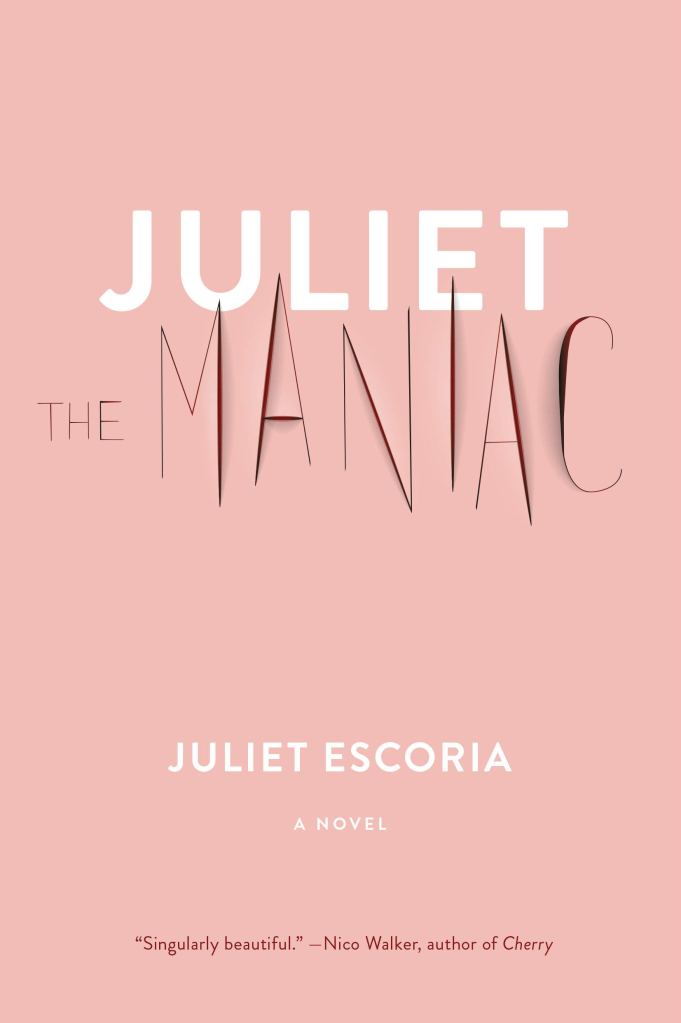
Like I said, the difficult stuff starts early and doesn’t let up. Escoria’s chapters are often short, the voice at once raw and detached from the events on the page. From self-harm to drug use to taking clothes from a dead girl in a dumpster, Juliet gives a matter-of-fact account of the events from her teenage years. Even sex hardly gets a rise in emotion. But now and then, adult Juliet puts in her two cents about her experience thinking back on those experience half a lifetime ago. Those recollections are far kinder to her teenage self than her teenage self is capable of at the time. The reassurance that Juliet does live to adulthood—and, even more remarkably, stability—is crucial for getting through some of the tough parts.
I’ll be the first to admit that I had a tame adolescence, as far as parties and drugs and troubled friends goes. Reading Juliet the Maniac was, in that way, a glimpse into the teenage existence my parents were warned I could slip into. I wondered, as I read, how I might have experienced Juliet’s descent as a teenager, instead of as an adult about the same age as grown-up Juliet capable of seeing this so-called maniac with more grace than I could have at fourteen, sixteen, eighteen. Still, Escoria’s voice helps makes that glimpse feel realistic, but so do the scanned-in hospital records, letters in childish cursive, and other “found” media that come from Escoria’s real-life experience.
In the author’s note of The Fault in Our Stars, John Green writes that attempts to separate fiction from its factual inspiration ignores the weight fiction can carry. I thought of this note a lot while reading Juliet the Maniac. But in an interview Escoria gave at the time the book was published in 2019, she talks instead about the freedom calling her memories fiction gives her. Fiction means not having to fact-check her recollection. Fiction means she doesn’t have to come up with a moral to the story of the teen years she barely survived. Yet Juliet the Maniac does end on an unexpectedly bright note. Whether that optimism is the light at the end of the tunnel for Juliet or a later invention from Escoria doesn’t matter as much as the relief it finally brings.
 Ring Reads