
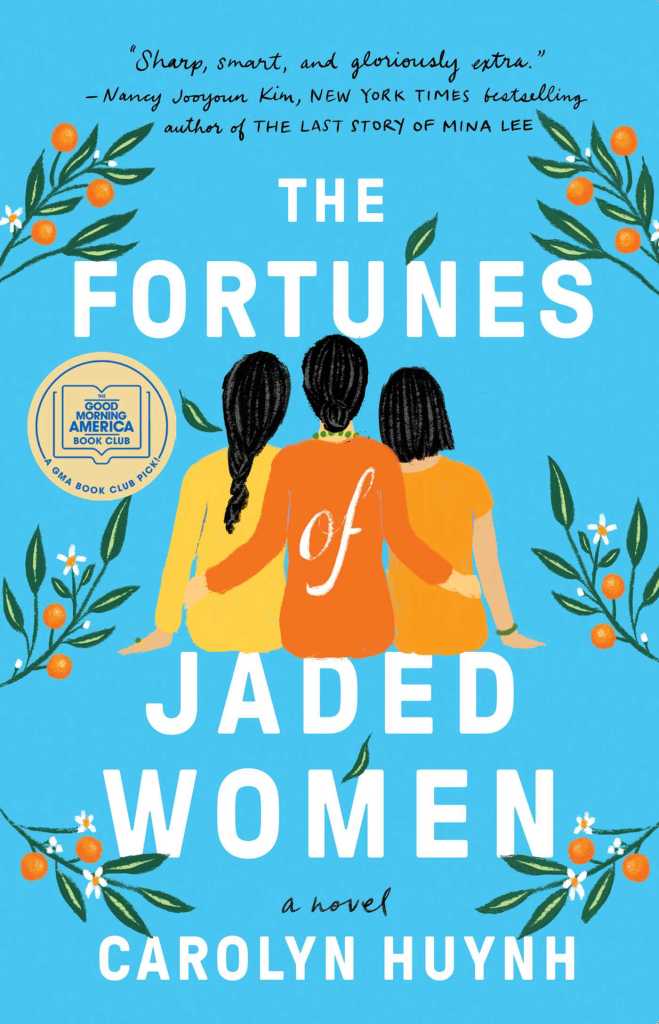
Family relationships can be hard under the best of circumstances. When those circumstances aren’t so great, they can get downright messy—and entertaining, for the outside observer (why do you think The Jerry Springer Show, The Maury Povich Show, and Keeping Up With the Kardashians have been so popular?). That messiness is the driver behind the plot of Caroline Huynh’s The Fortunes of Jaded Women and the disastrous relationships between members of this Vietnamese-American family who somehow, despite it all, really do love each other.
Mai Nguyen’s annual trip to her psychic in Hawaii has brought some alarming news: within the next year, there will be a wedding and a funeral, and if she doesn’t amend things with her two younger sisters, her mother, and her three daughters, she could lose everything. Mai reels at the news, both because of how dire the situation already is—their ancestor was cursed to only have daughters, and generations of women have proven that curse real—and because she really, really doesn’t want to.
She and her sisters haven’t talked for ten years, and when they reunite, the staff at the restaurant is right to be afraid of flying dishes. When the three of them confront their mother again, the atmosphere is likewise steely. Meanwhile, making things right with her daughters is going to be a challenge all on its own—the girls can barely get along with each other, let alone with their mother. It seems the family curse has gotten its claws in deep with these women, both in America and in their native Vietnam, and Mai might not be the best diplomat for smoothing things over. But improbably, it seems there might be hope yet for reconciliation—of a kind.
Although I centered Mai in that synopsis, The Fortunes of Jaded Women sprawls, giving point-of-view chapters to nearly all thirteen women across three generations. At times, it can get confusing, especially if you’re someone unfamiliar with Vietnamese names. I read this on audiobook, and I found that helped me keep track of characters—not necessarily by name, but by story. The one with the tech company. The one who accidentally takes her sister’s ex to a family reunion. The one obsessed with K-dramas. The one whose boyfriend brings her wildflowers. The one with the really cool two-tone jade necklace. While I did eventually attach the names with the stories, there’s a lot to keep track of in this multigenerational family, and there’s no way around that.
There’s also no skirting around the fact that these are all messy women. They harp on each other, they back-bite, they keep old grudges close, and lock away the love they think makes them vulnerable. The ripple-effects of trauma, displacement, and loss make waves rough enough to toss even the steadiest boat, and their boat isn’t all that steady. I’ve written before about how it can be refreshing to see “difficult” women in fiction, and I hold to that here. At the same time, there were some places where the tension bled uncomfortably out of the page. I would say I wanted to sit everyone down and mediate, but I married into a family that can feel this tense and talking-crosswise—with fewer fireworks than in this family, sure, but it still felt oddly familiar. Maybe that’s why I was rooting for reconciliation so hard.
But don’t mistake me—as the messy women with their messy plots wound themselves into a veritable knot near the end, I was racing through for the tea. An omniscient narrator helps foreshadow the crises to come, and I was watching them with as much voyeuristic glee as any of the residents of Little Saigon who knew that a meeting of this family was sure to end in chaos. These women could settle their differences much more calmly (and easier to follow for the casual reader), but that wouldn’t be nearly as fun.
 Ring Reads