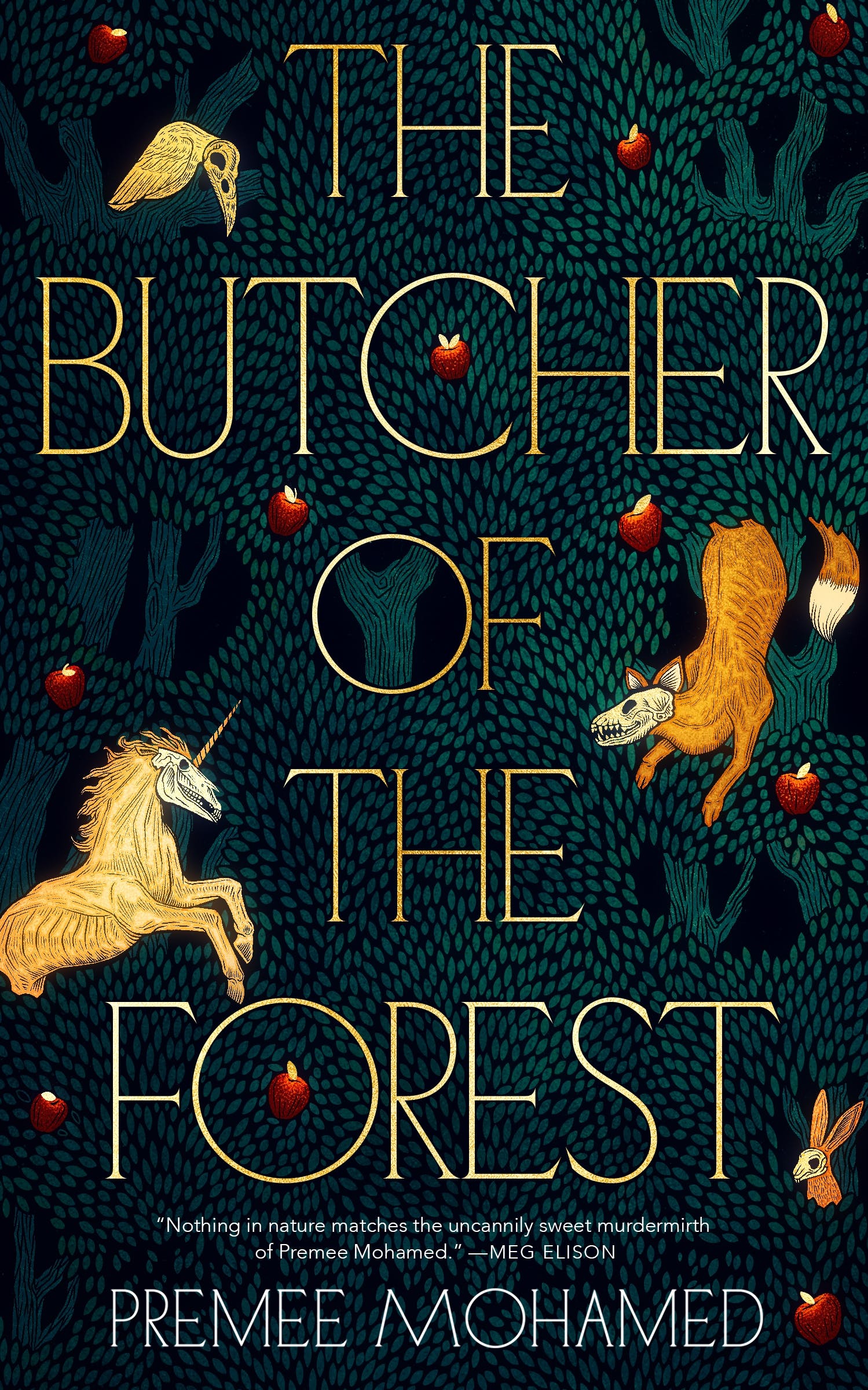
In Premee Mohamad’s slim The Butcher of the Woods, the hope that dies among the trees wasn’t very strong in the brightest of sunlight. That doesn’t stop its main character from plodding on and on along its treacherous paths.
Veris Thorn is pulled from her bed before the crack of dawn and dragged to the castle to face the merciless tyrant who has taken over the land. At middle age, she knows she’s too old for him to bed, and can’t think of any other reason she would have caught his attention. But what the tyrant wants is the last thing Veris is wiling to give: to venture into the northern forests and retrieve his two children, who wandered into them during the night. Veris is the only one who has ever come out of the forest alive, after going in to retrieve another child who wandered inside fifteen years ago. Veris brought that child back, and now the tyrant is demanding she do the same for his, or it won’t just be her life forfeit, but that of her entire village. He’s not called the tyrant for nothing, after all.
But the forest is more than just dense wood. Its magic is old and strange, and a stray step can mean a person is lost inside forever—or worse. As Veris ventures in again, she has to stay sharp to retrieve the children, but it’s hard when the forest is always changing. With not just her life or the children’s lives on the line, the stakes could not possibly be higher. But success also means confronting memories and emotions that have been pushed away for fifteen years, and that might be too difficult for even Veris to face.

This isn’t a fairy tale, nor does it read like one, exactly. But it does carry the weight of all the tricky and capricious forests of every fairy tale ever told; are the prince and princess walking through the trees all that different than Hansel and Gretel? The house Veris encounters deep in the woods doesn’t stand on chicken legs, but it carries as much danger as Baba Yaga’s. The talking creatures might say they mean no harm, but there’s little more foolish among the trees than trusting a person or thing you didn’t carry in with you. If The Butcher of the Forest were a story based entirely on vibes, Mohamad would have already succeeded.
But the trauma at the heart of The Butcher is something wound as tightly around every detail as tightly as ivy on a tree. At every turn, Veris is reminded of her last trip through the forest, which starts a cascade of memories that she has tried very hard to forget. There’s a difference between surviving something and coming back whole, Veris notes early in the book, and it while it initially seems that she was referring to the child she retrieved on that first trip into the woods, it becomes increasingly clear that she’s the one who hasn’t been the same since. That growing clarity underscores just how slim the odds are for the children, who, despite being groomed to take the place of their bloodthirsty father, are not yet anything but innocents.
In a way, the forest is a metaphor for internal trauma, where the very air can twist the most innocent things, and where stepping off the few safe paths means instant peril. It’s just a patch of woods, nothing very significant, except for its power to swallow anything that ventures too deeply into it, and goes far darker and deeper than what appears possible on the face of it. For Veris to tread every path perfectly with two unruly children only partially tamed by the danger they’ve put themselves in is impossible, and Mohamad does Veris the honor of not bending narrative time and space to overcome the odds. Instead, the ending is unexpected, and stranger and sadder in the absence of the magic that coats so much of the rest of the story. In Veris’s world, there never was a happily ever after her—but the alternatives aren’t all uniform in their unhappiness.
 Ring Reads