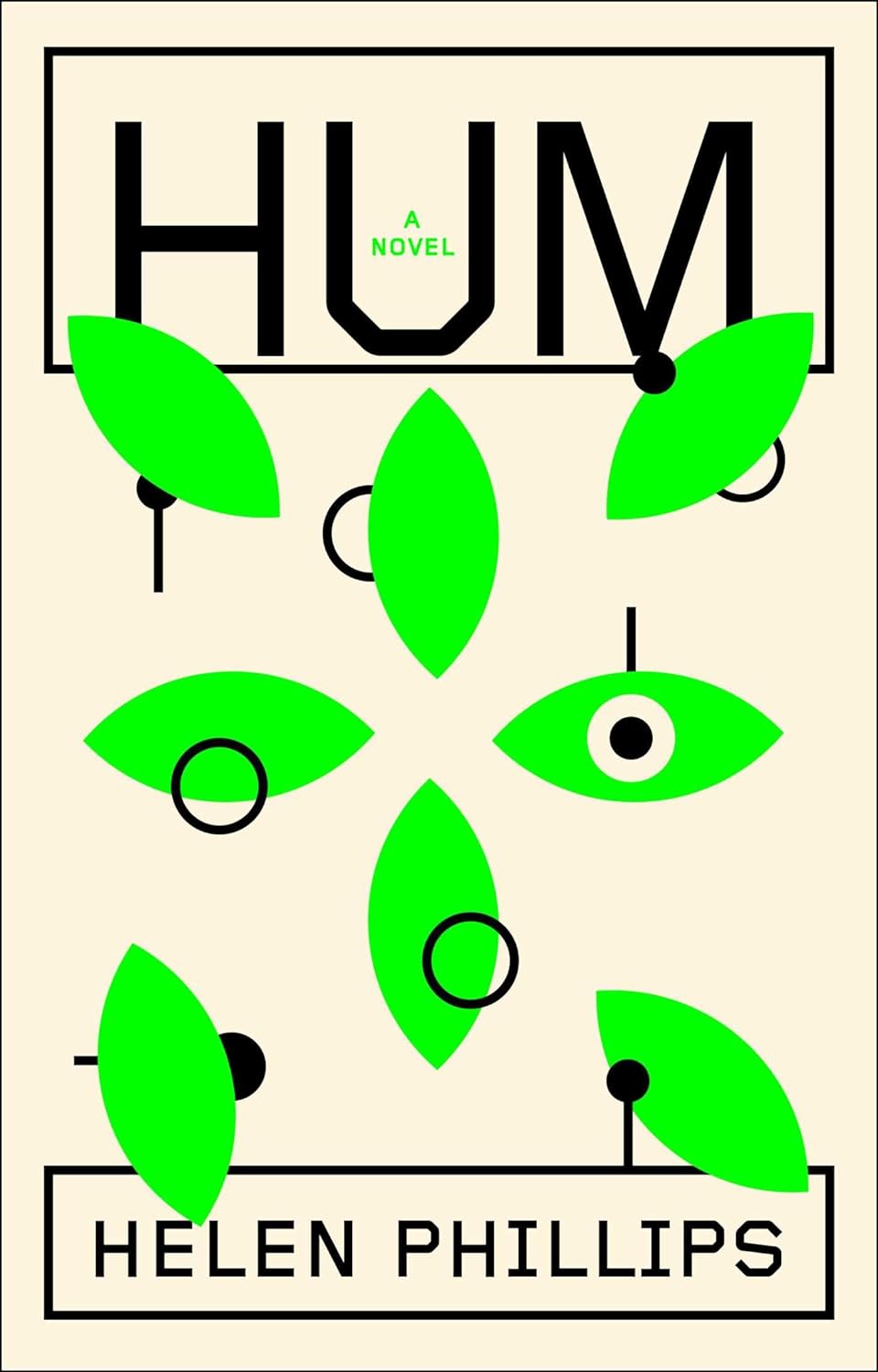
The future feels like it comes fast, and it frequently comes with things worsening: the climate, politics, the internet. Helen Phillips’s new novel, Hum, takes all the bad things, imagines them being a little worse, and then stuffs them all between a slender cover.
May was a little too good at programming and training AI, and now she’s made herself obsolete. Her partner, Jem, is taking as many gigs as he can, but money is tight for May and Jem and their children, and only getting tighter. Desperate to earn money, May agrees to undergo an experimental procedure that will render her face invisible to facial recognition programs. With the sudden influx of funds and a desire to escape from a world choked with pollution, global warming, and erratic people, May drops a chunk of her new funds on a three-night stay at the Botanical Gardens, an oasis of clean air, fresh water, and thriving flora and fauna.
In her quest for the family to make the most of this expensive peace and quiet, May mandates a no-devices policy: no phones for her and Jem, and no wrist devices for the children. Despite her children whining and missing the convenience of having maps and messages at their fingertips, this quality family time is everything May had hoped. The illusion of harmony abruptly ends when May’s children wander away, and their missing devices—as well as May’s unidentifiable face—make what should be a quick reunion into a viral story. The repercussions of the family’s getaway last far longer than their vacation, and are centered squarely on May.

Phillips has drawn a dire near future, and one based firmly in distressing headlines from the present (as provided in a sizeable section of works consulted in the back). People constantly tethered to their devices. Air too polluted to safely go outside. Widespread financial struggles and housing shortages. Ubiquitous and targeted advertising. There’s a lot that’s familiar with the world May inhabits. It’s debatable whether that imagined future is realistic or dystopic, but either way it’s a depressing and claustrophobic place. This is no doubt by design, as the environment makes it easier for us to understand why May’s anxiety is constantly through the roof, though it makes this a book I might not take on a relaxing vacation.
Despite Phillips’ various themes of unchecked AI, climate change, and device reliance, the real crux of Hum is in cancel culture and how having cameras everywhere we turn—in our phones, at intersections, in stores—means anyone could have a bad moment captured and shared without context to millions of strangers. It does, however, take a while for the book to lead up to May’s nightmare realized. Until that point, the other themes are far more prevalent, and their stepping aside as supporting cast is unexpected. By the end of this short, tense, and busy novel, we come full circle, the repetition and futility to escape it as much a part of the message as anything else.
 Ring Reads