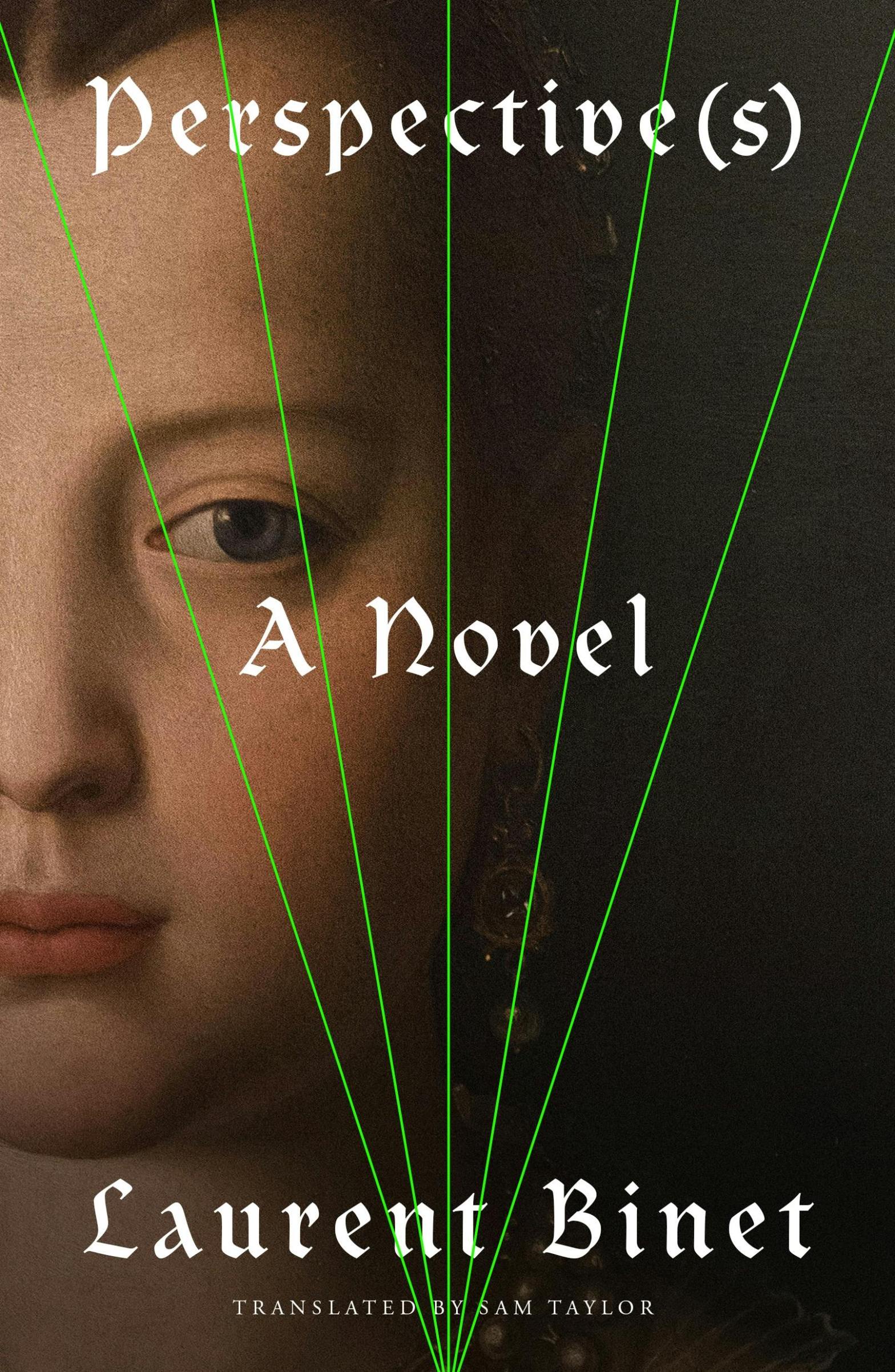
It’s not nice to gossip and everyone knows reality television is the entertainment equivalent of, like, Surge soda. Getting your fix of that kind of plotting and backstabbing from historical fiction, though? That’s just called reading. Take Laurent Binet’s Perspective(s), now translated from its original French and ready for you to pick up and get in on all the drama in a court in sixteenth-century Florence.
The grisly death of a painter, Jacopo, found in front of a fresco-in-progress in a Florentine church sets off an investigation—one made more urgent by the discovery of a painting within his studio depicting the duke’s daughter, Maria, in a rather compromised position. Such scandal could derail her advantageous marriage to the brutish son of a neighboring nobleman. The duke demands the painting be immediately confiscated, even as the investigation continues. But the picture soon disappears as part of a plot to undermine the duke by his cousin, Catherine, the queen of France. The duke’s investigators furiously try to solve both the murder and the theft of the painting with leads that stretch as far as Michelangelo (yes, that Michelangelo) and as close as the duke’s own wardrobe.
Still, they seem to discover only side plots and dead ends, including a minor “plebian uprising” (read: unionization attempt) by one of Jacopo’s employees and a disagreement on artistic style between nuns. Meanwhile, a page of the duke has promised Maria that he’ll personally make sure the offensive painting is destroyed—promises that quickly turn into promises of love. Maria asks Catherine for her advice, and then support, should she elope with this commoner and flee to France, becoming yet another moving piece in this tapestry of plots and betrayals and subplots and back-stabbings that all seem to reveal more questions for the duke’s investigators than they answer.

Told entirely through letters between the involved characters, the many threads of Perspective(s) can easily get tangled if you don’t keep a thumb in the list of correspondents. This works very well for the most part, making the unfolding story feel like gossip you’re gradually uncovering rather than reading a proper book. It walks the tightrope of sounding like authentic written correspondence while divulging enough details that we outsiders get adequate context. We don’t need more explanation from the narrator—in this case, a traveler who introduces the book by telling of a fortunate discovery of this bundle of letters at a flea market in Tuscany—but I also wouldn’t mind a little more from the narrator; other than the tale of discovering the letters and a few historical details like the difference in date of the new year and telling time in sixteenth-century Florence, our narrator is really a silent facilitator. It works, but it also makes the framing device feel superfluous, a detail added in the beginning but forgotten before the midpoint.
Among all our characters and all their plots, there are few to root for. The investigators are ostensibly the ones seeking to right a wrong, but they’re also an extension of the will of the duke, who may be a product of his time but is not exactly what you’d call a benevolent leader. There are the plotters who are trying to remove the indecent painting from Florence, but their promises to destroy it are transparently empty and their ultimate goal isn’t better than anything the duke could come up with. The artists on the fringes of the whole affair, including the one preaching the heresy of workers’ rights, are sympathetic characters, as are the nuns and the foolishly lovestruck Maria. For them, they struggle to find a comfortable space between the bars of oppression. Some of them find it, while others aren’t so lucky.
Yet this isn’t the kind of book that makes you feel like the bad guys win, or that there are no victors worth rooting for. The epistolary nature of Perspective(s), along with the framing of the letters as centuries-old discoveries, blunt the unfolding of the unhappier plot elements, letting us sit back and relish the political intrigue. It carries the same kind of popcorn-munching near-taboo feeling as watching some really petty reality television. But it’s about art, and it takes place in sixteenth-century Italy, and it has Michelangelo in it, and that totally makes it respectable. Read with abandon.
 Ring Reads