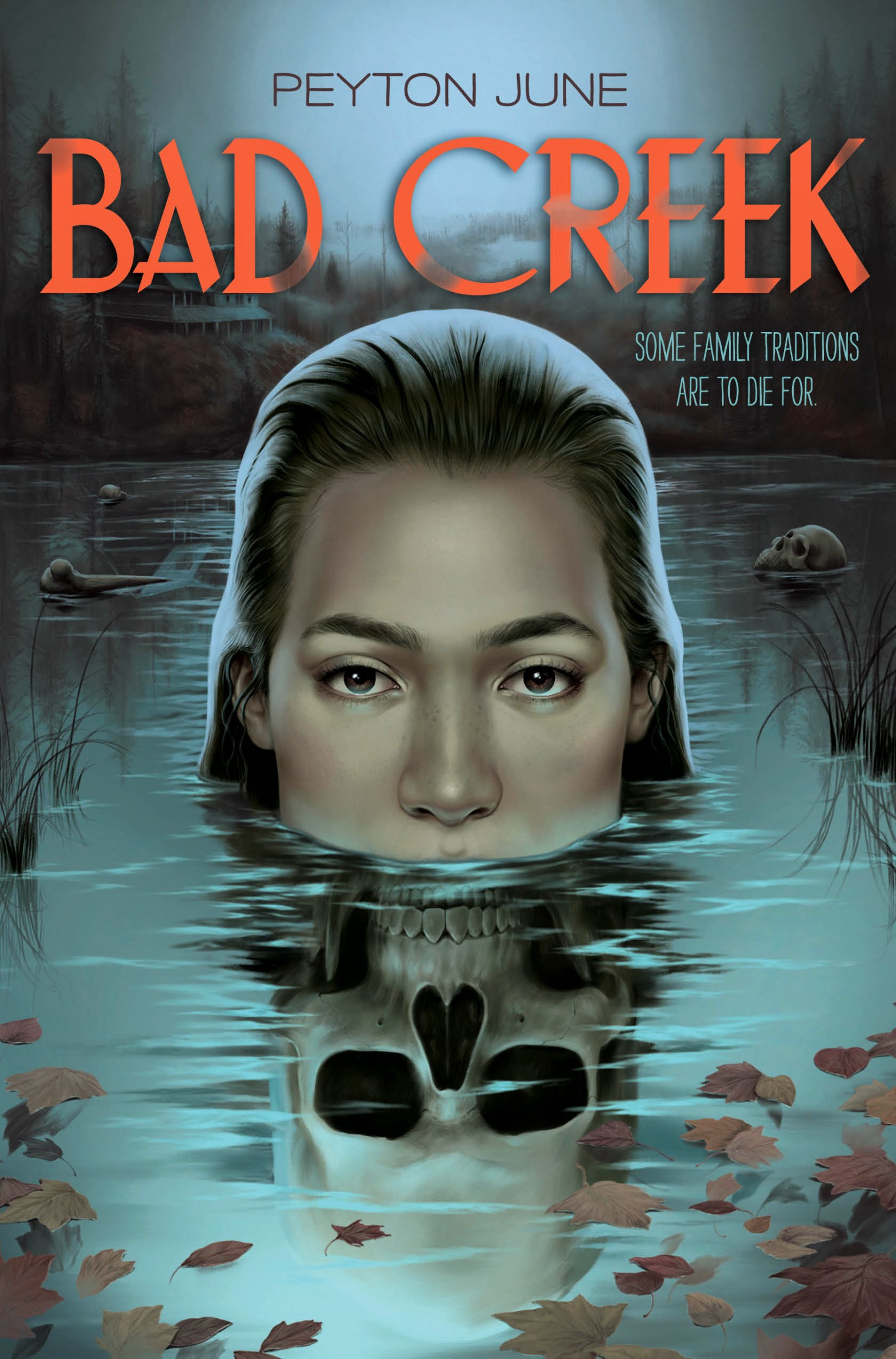
I’m always down for some good spooky Halloween fun, but autumn much too confidently enjoys the reputation as spooky season. The world may not be in a period of death and decay in the lead-up to winter, but nothing rots as quickly in October as it does in July. Peyton June’s Bad Creek is fresh on the shelves to make the most of the summer haunting season with a story of grief and generational curses.
As July approaches, Iris heads back to Bad Creek for her family’s annual trip to the small Michigan town, assured that her friends Aidan and Gum will be there, too, just like the three families have been doing since their parents were teenagers. This year, though, the feeling’s a bit different: after all, it was during last year’s trip that Iris’s big sister, Glory, drowned. Her ghost is woven in everything, from the annual traditions to the bike she always used. Worst of all, Iris isn’t sure she believes the official story of what happened to Glory. After all, everyone seems to be hiding something, even her friends.
The three musketeers discover a pattern of strange drownings or near-drownings through the years, further stoking Iris’s suspicions. Gum didn’t need anyone to tell him Glory wasn’t the first drowned girl in Bad Creek: he’s been seeing multiple ghosts, including Glory, at every turn, and they’re getting more insistent as the week goes on. Aidan, meanwhile, has his own secret about what happened last year, making him afraid he unintentionally contributed to Glory’s drowning. Add in Gum’s snobby cousin Hudson suddenly acting suspiciously friendly, as well as the old-timers refusing to talk about the other drowned girls, and it’s obvious there’s some dark undercurrent running through Bad Creek. It’s less obvious what that darkness is, or if Iris will survive this investigation—or this trip.
Bad Creek feels at times like a sequel to a story of Glory’s death, and can be a little disorienting as a result. But with a few minor exceptions, that works to its thematic advantage, considering how jumbled grief can make reality. In the same way grieving is often harder on anniversaries and holidays—times when things feel the same as always except for the loved one’s absence—Glory’s haunting of the titular town feels perfectly fitting in a metaphorical sense well before it becomes literally true.
Perhaps even more present is the specter of family expectations. Most pressing is Gum’s unexpected chance at making his mom’s side of the family proud of him for once, even if he can’t possibly understand the cost to do so. Aidan wants to be nothing like his father, who still clings onto relevancy from a cult-classic horror movie he made decades ago. Iris’s uncertainty of how many of her choices are her own and how many are made with Glory in mind one way or the other. Even snotty Hudson, formerly the golden boy of his family, has to figure out a way to be more himself and less an offshoot of his forefathers. The ways these teenagers have to identify, or re-identify, themselves may be a little gorier than what the usual high-schooler experiences, but it’s a relatable feeling all the same.
So is the growing understanding that much of the conflict—the trauma, The Way Things Are, or the curse, if you will—has its roots in the actions and needs of previous generations. Even in the real world, with much more space for outside influences than the plot of a novel, much of what we face on both a large scale of global politics and the small scale of family norms comes from people who did things and died long before we, or even our parents, were born. Often, we can’t possibly know what lurks beneath the waters of history, despite feeling its ripples every day. In the same way, we’re unlikely to second-guess what it gives us, or its cost. In the case of Bad Creek, the ghosts and the monster they’re tethered to are close enough for our main characters to smell and touch, and real enough to make me wary what’s hiding in the local river.
 Ring Reads