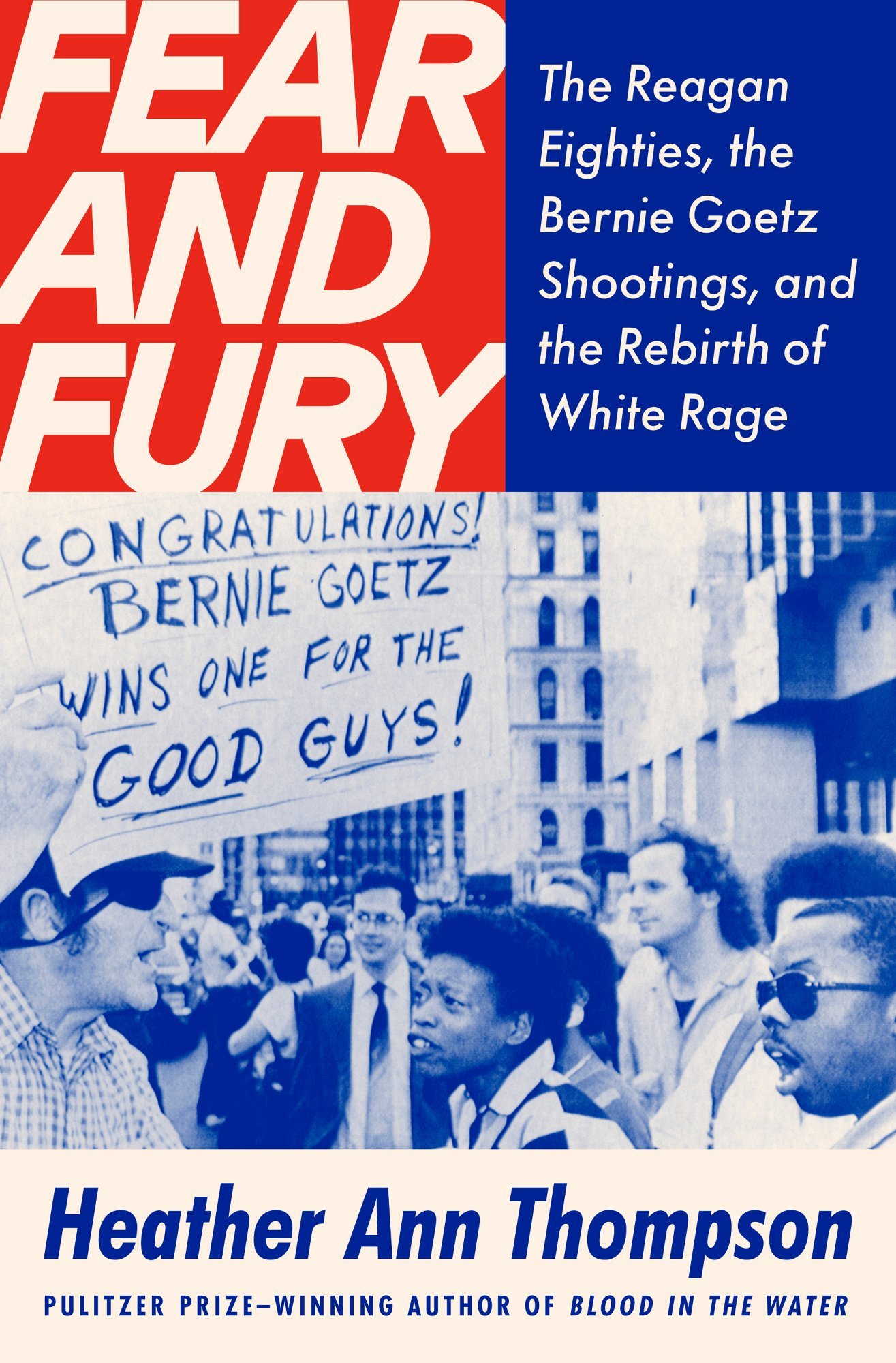
It’s not often I feel physically ill when reading (with the exception of reading while in a moving vehicle). But historian Heather Ann Thompson’s Fear and Fury: The Reagan Eighties, the Bernie Goetz shootings, and the Rebirth of White Rage required a good many pauses until my head cleared. Not from the prose itself, but just from the sickening realization that the present is sometimes little more than a house haunted with the ghosts of the past.
Just before Christmas 1984, a group of four Black teens approached a white guy on a New York subway car. One asked for money. The man, Bernhard Goetz, shot all four of them and then fled, leaving the teens bleeding in the subway car. Few of the facts of the incident were ever in question, thanks to multiple witnesses and Goetz’s own frequent retellings of the incident. Instead, the shooting kicked off a firestorm of public opinion about the attack, which resulted in all four teens being seriously injured and one sustaining paralysis and permanent brain damage. Specifically, whether Goetz’s response to this attempted panhandling constituted reasonable force.
As a clickbait headline might say, the result might surprise you.
The New York City of the 70s and 80s is admittedly hard to grasp after seeing it some gritty but magical backdrop to what seems like half the shows that populated movies and TV as I was growing up. It’s difficult to conceptualize beyond a strictly academic level not only what such a domino effect of disenfranchisement and decay would have on a city, let alone how bad conditions had to have been for Goetz’s guilt to have ever been in question, let alone him being acquitted. Harder still, though, is seeing uncomfortable echoes from the history forty years past and current events, when observers are killed and families are gassed for the crime of being in the wrong place at the wrong time—and having a very loud and uncomfortably large minority crowing about it.
Thompson’s tone is not one of the unbiased journalist merely presenting the facts from a remove of decades, but a historian connecting threads and highlighting hypocrisy in ways that may not have been acknowledged at the time and has since fallen out of public attention. This rhetorical choice might alienate some readers, but history isn’t something that can be told without bias, and at least hers is clear and well documented. She gives context not only for the shooting that was to take place in December 1984, but she then connects the shooting that resulted from those complex social and political circumstances to our current moment. It’s hard seeing the similarities between then and now, especially with the distance even recent history affords.
I would say there are no winners from the moment in question, but the worse part is the realization that there, in fact are winners. Rupert Murdoch made out like a bandit, drawing in strong readership to his new U.S. venture with continuous coverage that inflamed and occasionally informed. Forty years on, the ripple effects from that success are still rocking boats and alienating friends and families from each other. Rudy Giuliani, then U.S. district attorney, gained prominence through his unwillingness to let the civil case against Goetz go through, paving the way for his mayoral bid and ultimate rise in political cache. Giuliani found a friend and like mind in Donald Trump, who by this point was already in possession of any number of awful ideas. All terrible people finding their people, capitalizing on sensationalism, half-truths, and overly simplistic black-and-white answers to complicated shades of gray.
And here we are.
Thompson does not, it should be said, draw a straight line from Bernhard Goetz to a present filled with deadly immigration enforcement operations and global movers and shakers who were pals with some guy named Jeffrey Epstein. Rather, it is a moment on the timeline from the hopeful civil rights expansions of midcentury to today. It is positioned as a lightning rod that captured long-simmering frustration and was capitalized on to further an agenda, and an instant that perpetuated and reinforced our fluctuating demand for perfection from victims and excuses for offenders. The ideas that led to the shooting and Goetz’s subsequent exoneration are still alive and well, and while it may not be easy, it’s crucial to understand and confront them.
 Ring Reads