
Entertainment borrowing from the horrors of real life has got to be as old as entertainment itself. But there’s a difference between media exploiting the truth and using it as a jumping-off point for highlighting or thoughtfully discussing a persistent issue. The latter is the case in Blood Relay, the latest from scholar and author Devon Mihesuah.
When a young and promising Indian Horse Relay rider disappears, Perry Antelope gets the call. Perry, a seasoned detective, and her partner, Sophia Burns, see troubling signs of the woman’s disappearance: a screw drilled into the woman’s tire and a sabotaged gas tank both ensured that she wouldn’t make it far after leaving the racetrack. The woman’s disappearance also ties into a pattern of other missing or murdered women from local Oklahoma reservations. Their investigation is hardly underway when the stakes get even higher as someone begins targeting Perry specifically.
More determined than ever to find the missing rider, Perry and her partner comb through layers of motives, secrets, and grudges to figure out who would have a reason to plot against this elite athlete, and whether—or how—her disappearance fits into the string of other missing women. Throughout, tribal beliefs and tangled family relationships weave in and out of the ticking clock that is Perry’s case.
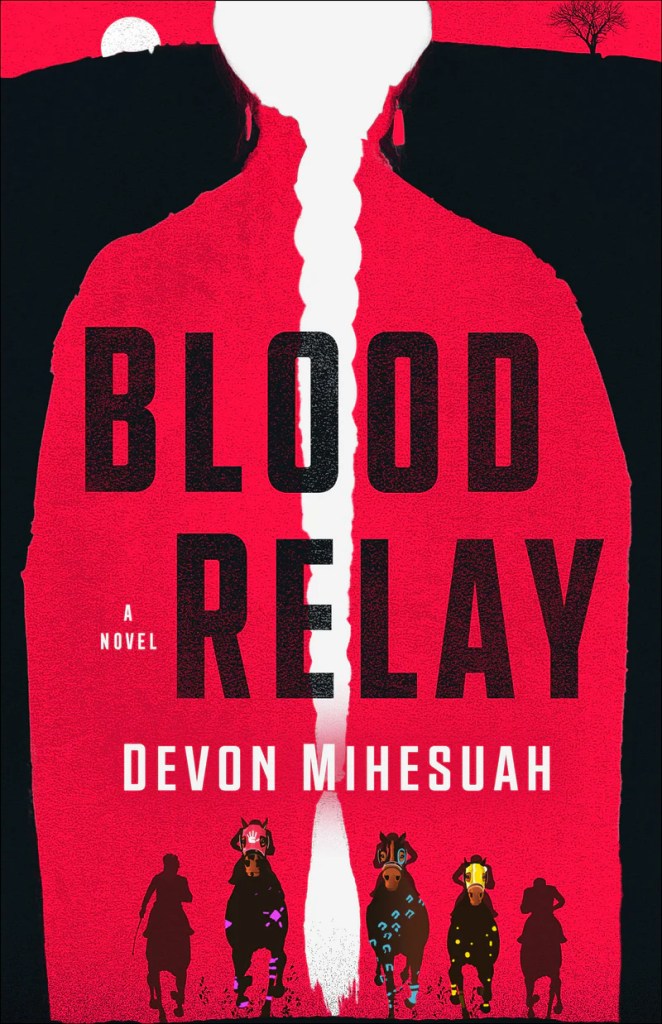
I’m somewhat familiar with Mihesuah’s work, though I hadn’t realized she had published so much fiction. Blood Relay is the latest in a half dozen or so thrillers starring female investigators. I was less surprised by that than I was by the fact that, as far as I can tell, this is the first time Perry has been her main character. Perry and Sophia, though only paired together for six months before the story begins, have the kind of easy familiarity that can only be built through going through some real trouble together. In addition, the story references past cases, and scrapes, in a way that makes me feel like I’ve picked up the middle book in a longstanding series. Quite a lived-in feeling for a first foray.
I’m always interested in how true events get used and imagined, and sometimes solved, in fiction. In the case of Blood Relay, a troubling pattern of indigenous women going missing or turning up murdered has been prevalent throughout North America for decades. Mihesuah takes this real-life crime as only the first of the problems for her characters to solve, tacking on complications like intertribal and interjurisdictional issues and a town turned into an environmental wasteland by pollution.
None of the issues that Mihesuah incorporates into the story are done so subtly. The town I mentioned isn’t exactly Chekhov’s Superfund Site, but when they do pass it late into the book, it’s clear it won’t stay a distant threat. The kidnapped rider isn’t alone in her captivity, nor is her disappearance a one-off crime from her captors. Then again, none of these issues is exactly cutting edge; they’ve been ignored, dismissed, shrugged off for years, decades, over a century. Maybe what they need isn’t subtlety, but to be shouted from the rooftops.
Mihesuah, with her career of writing and scholarship, has the experience and the platform to let them do just that.

