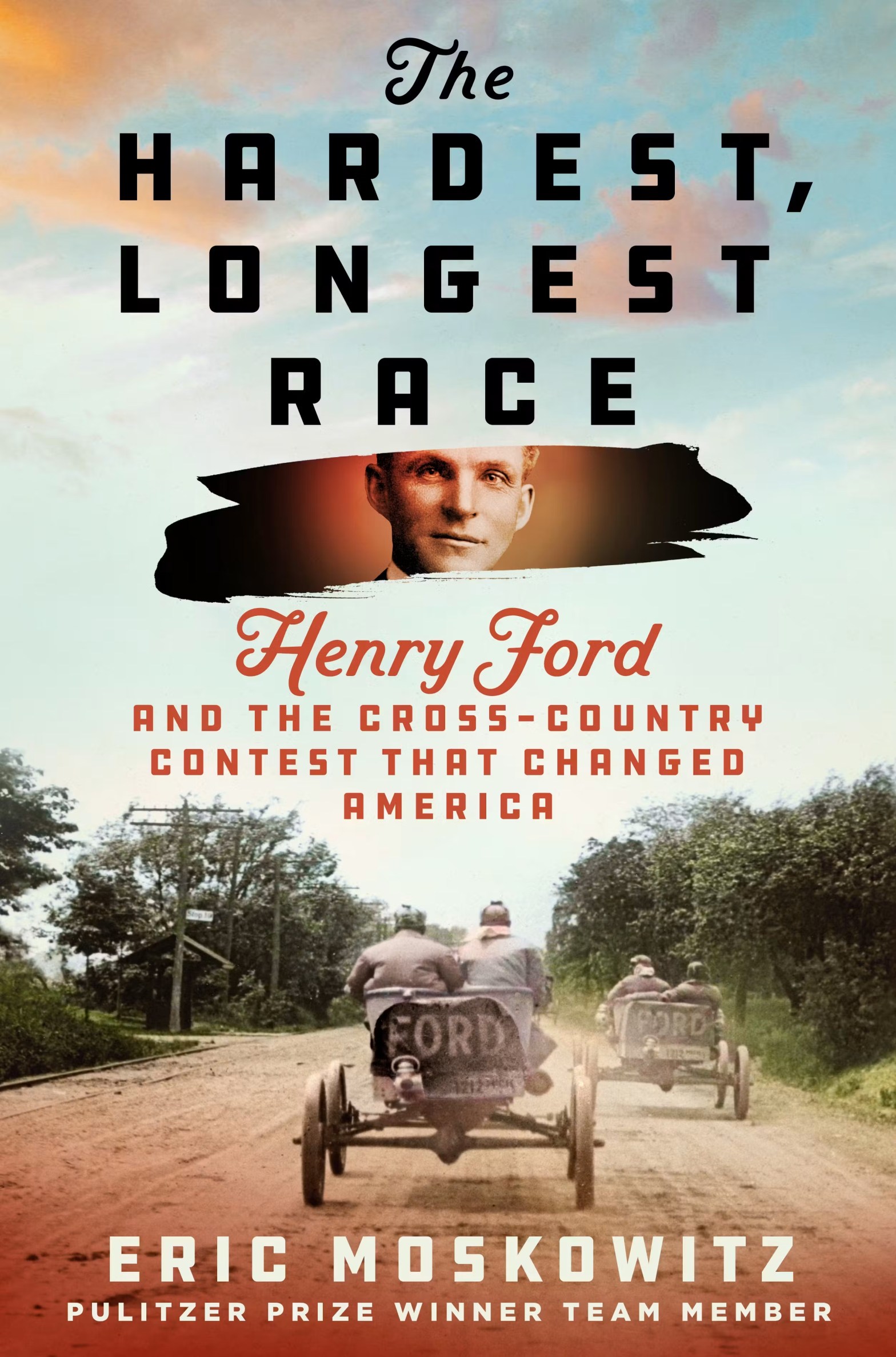
Summer and road trips seem like an ultra-American match made in heaven, even for those of us who’d rather stay home. In journalist Eric Moskowitz’s debut book, The Hardest, Longest Race: Henry Ford and the Cross-Country Contest That Changed America, the story of one of the earliest summertime road trips across the country reads at times so realistically you might start feeling carsick.
The premise of the race is simple: a vehicle race from New York to Seattle. There are checkpoints dotted here and there, and some rest requirements. The cars can replace most parts as necessary, like ball bearings and tires or wheels, but major components like the engine and axels are stamped in New York to make sure they are only repaired, not swapped. Two drivers and a mechanic can ride in each car, but the three have to stay in the race the whole time; if illness or injury forces a member of the team to have to stop, they can’t later rejoin the car. Considering the ad hoc nature of the road system in these pre-highway days, however, the teams can hire local guides as often as they like.
Although more than three cars headed west from the New York starting line, it quickly becomes apparent this is a contest between three cars representing two companies: Ford and Shawmut. Ford’s two Model Ts gave the company twice the odds to reach the finish line victorious. The performance of the Shawmut could make or break the fortunes of the company, whose rising success has been hindered by a fire that destroyed the factory, and the cars in it. For reporters and spectators all along the race route, the cars represent the bright or baffling future of vehicular travel barreling toward them. As the cars face poor roads, unpredictable weather, and a chaotic system of railway and river crossings, the nail-biting nature of these top three contenders lasts right through the finish line.
The opening chapters of The Hardest, Longest Race are an avalanche of context, setup, and character introduction. It’s interesting, but it also gets a little overwhelming at times. I was reading this as an ebook and wished I could more easily flip back to make sure I was keeping this element or that straight. But by the time the cars hit the road, my attention was as rapt as any of the bystanders. It’s a real trick making the race seem like a neck-and-neck thing, even if it was, given that you can about guess who won from the beginning. After all, Ford has been a household name for generations, while few have heard of the Itala or Shawmut. (A fifth car, the Acme, appears with no Loony Toons references.) As the race unfolds, however, Moskowitz skillfully complicates the view of Ford as the assumed winner, as well as the future of automobiles as a given.
It’s clear even before you get to the sources in the back that Moskowitz has done extensive research about the race, and uses what he’s gleaned to really bring the characters and the challenge to life. This applies not only to the racing teams but bystanders, as well, from the black sheep of the Guggenheim family to a young J.C. Penney to the first Model-T owner in Meridian, Idaho. Some of these narrative tangents feel like detours to a larger destination, while others are more like Sunday drives taken solely for the pleasure of it, but all contribute to a mosaic of what the race meant to different people and different places. It’s hard, of course, not to wish there was more of one character or another, and you wonder what kinds of editorial conversations decided who got cut and who got to stay in the final draft. It was hard while reading to not get the sense that Moskowitz was trying hard not to paint anyone as a villain, no matter how easy their actions during this time might have made it to do so.
The Hardest, Longest Race at its core is about the struggle between the past and the future, between companies vying for first in the court of public opinion and the employees just here for their paycheck, and between what’s true and what gets remembered. I enjoyed every minute of it.

