
I love murder mysteries in all their fictional forms. Your basic boiler-plate whodunnit is usually enough to draw me in, but I do always appreciate an extra element. I was intrigued, then, by the premise of Ramona Emerson’s Shutter, about a young Navajo woman working as a crime scene photographer in Albuquerque—and who can see the ghosts of the dead she photographs.
As the book opens, Rita Todacheene is photographing a particularly grisly death of a woman who apparently jumped from an overpass to her death on a busy highway and whose body was then further mangled by traffic. But this victim, Erma, won’t leave Rita alone like most do. Erma insists Rita solve her murder, and her insistence only grows when her death is ruled a suicide. Aside from the breach of protocol this would represent, Rita has a more pressing problem when it comes to making Erma happy enough to leave her alone. Early clues point to potential corruption in the police department and a connection to a cartel, and Rita quickly realizes she’s walking on the thinnest of ice. Meanwhile, memories of young Rita tell about how Rita discovered and developed both her ability to see and communicate with the dead, and her passion for photography.
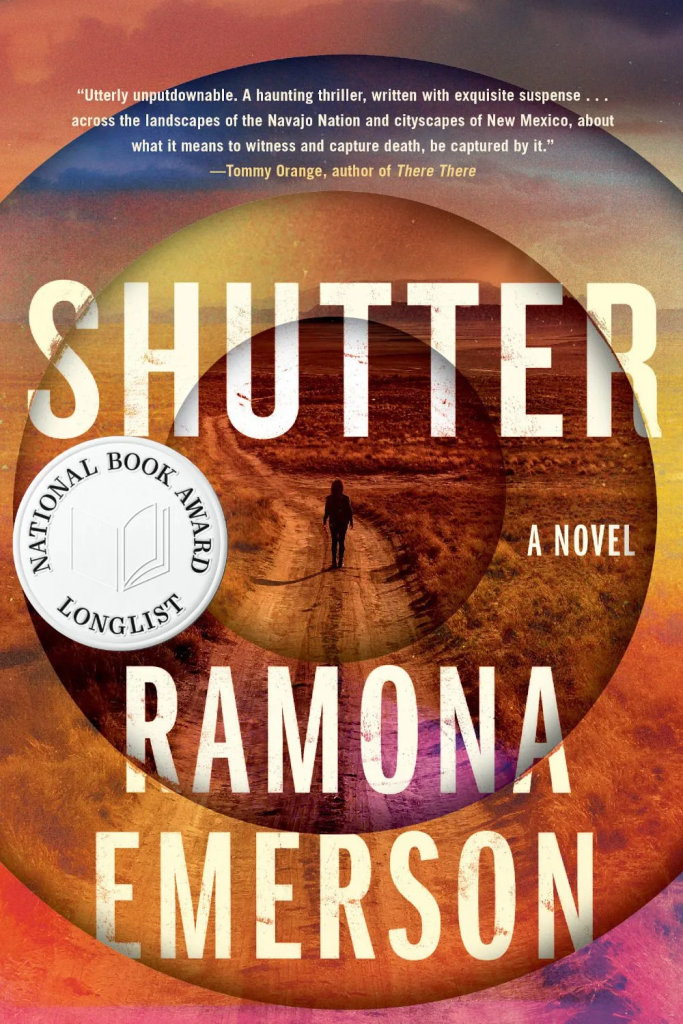
There’s a lot to love about Shutter, and it definitely had me turning pages. Rita’s ability can be a curse far more easily as it can be a gift, as her grandmother and the medicine have both warned her. Her years of ignoring them have heavy consequences now, even if her reasons for doing so are relatable. Just as she is simultaneously navigating the world of the living and the world of the dead, she must also navigate her professional and personal lives. In both cases, the two collide in sometimes dangerous ways. Still, she presses on.
Each chapter of adult Rita is interspersed with an episode from her childhood and early adulthood, of being raised by her grandmother before being reunited with her mother, and then clinging even more tightly to her grandmother after her mother’s death. These past chapters are quieter and more reflective—even when death and ghosts and arson are involved—almost like there’s a coming-of-age story shuffled in with the murder mystery. I loved these chapters, and the breathing room they gave only made the tension of the present-day mystery all the tighter. The pull between Rita’s cultural beliefs and the reality of her abilities throws a fascinating wrench into Rita’s already-delicate life balance.
The biggest weakness in Shutter is Rita’s extremely poor decision-making abilities. Given the choice between a common-sense approach and an idiotic one, nine times out of ten she’ll take the one that leads to her having to run for her life. Rita seems like a smart person otherwise, too, so her decisions feel extra baffling. For example, her abilities are supposedly something she keeps a secret, yet she tells them to the exact wrong people at the exact wrong times despite already having multiple historical examples of when telling someone went very badly. Erma’s demands drive Rita, but near the end, they also seem to drive her beyond reckless and into the realm of stupidity. While the results of all these bad calls propel the story forward and give us the kind of danger you expect in a thriller, the slasher-flick levels of decision making here. They’re not so bad in the beginning, but by the end it was hard not to feel blasé about Rita getting killed by the cartel or tormented by ghosts. You can only say “Don’t go in there” so many times before the consequences feel earned through that repeated stupidity.
Which is really unfortunate, because otherwise Shutter has the makings of a fantastic story that takes its character far beyond the tropes of a typical murder mystery protagonist. I wanted to love this book wholeheartedly, but by the climax, I only felt exhausted.
 Ring Reads