
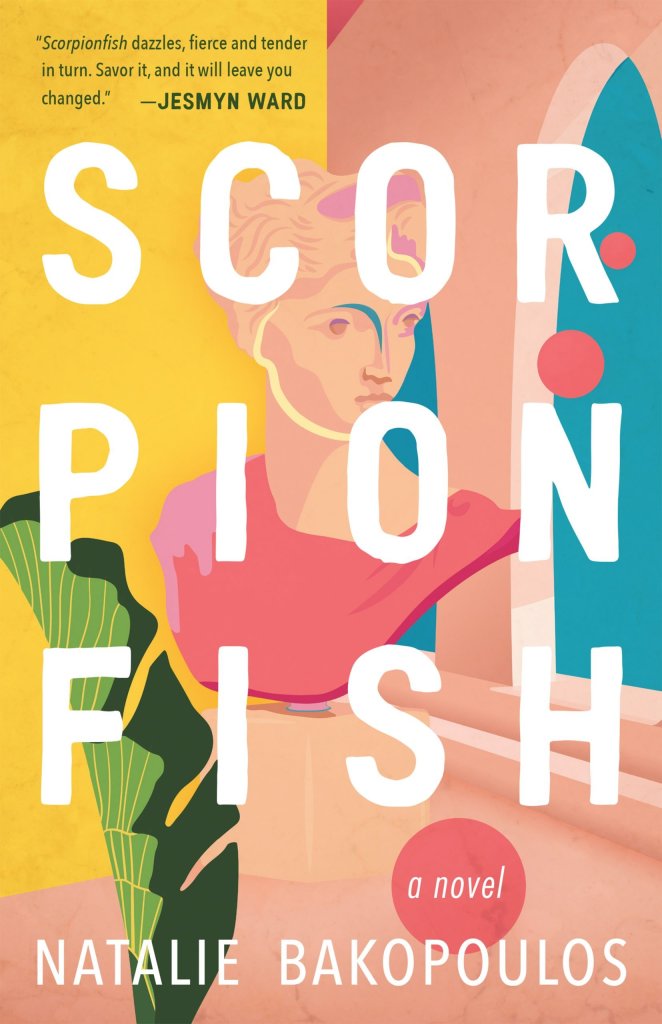
I’ve been thinking about it, and I’m not sure whether a lot or a little happens in the pages of Natalie Bakopoulos’ Scorpionfish, just that it was the perfect companion to the first lazy reading days of the year, swaying in a hammock that still has some of the winter’s dust in its nooks and crannies. Languid and pensive, Scorpionfish is a story as melancholy as it is dreamy.
Mira has returned to her native Athens a few months after her parents’ fatal car crash and subsequent funerals. Although she’s taken annual trips back to Greece, it’s her first time back in the family apartment, where her parents had intended to retire to and where her paternal aunt had lived prior to her death several years earlier. Those four walls, then, are steeped in family history and loss, and that’s even before she discovers the reason for her situationship’s recent distance: he’s engaged to his extremely pregnant fiancée, despite being at Mira’s side for her parents’ funerals just a few months before.
But loss isn’t the only thing Greece has in store for Mira this summer. Her aunt’s long-time partner, Nefeli, a well-known artist who has remained close to Mira even after her aunt’s death, is a pillar for her even as Nefeli’s own behavior becomes increasingly bizarre. Next door, Mira meets a new neighbor referred to only as “the captain,” and he has retreated to his apartment amidst his own turmoil. A teenage refugee staying with friends of Mira’s is an unexpected force of creativity and optimism despite his displacement and the fracturing of his own family unit. As Nefeli gears up and then launches a provocative new exhibit, and as Greece and its inhabitants feel the strain from the prolonged economic crisis, Mira find she can no longer run from the grief she’s evaded for months.
Mira isn’t a particularly dynamic character, but there is power in the understated way she grapples with her feelings. Her relationships with her parents weren’t straightforward, but that complexity doesn’t mean the loss cuts any shallower. In fact, now that she’s back in Athens, she sees the ghost of her mother everywhere: on the park bench, in a bar, over her shoulder. In Athens, memory carries weight. Meanwhile, her situationship wants to brush the romantic aspects of their years together under the rug and carry on as if nothing else has changed, forcing Mira to reconsider who she is alone and what comes next for her in a life that doesn’t include him. “I’m romanticizing it a bit, I know,” she reflects, “but I really loved this life [with him]. It’s when I felt my best, truest self.”
The chapters of Mira’s grieving and rebuilding in Athens are interspersed with the captain’s own little catastrophes with his career and fractured marriage. The apartment allows him to rest in a liminal space between the before and after of both of these problems, and when forced to leave it, he finds he’s become most comfortable in the in-between. Athens may be a major international city, but it’s a small place, too, and he and Mira’s lives overlap in multiple ways despite them never having met before her arrival. It’s a prime setup for a meet-cute, but Bakopoulos is far more interested in the inner lives of her characters rather than their sexual ones. (The few sexual encounters that do occur are less fade-to-black and more fodder for subsequent emotional reflection.)
While the emotional landscape and social circles of the two point-of-view characters in Scorpionfish have many similarities, their responses to the unfolding situations are from different planets. Mira is honest about her feelings, no matter how ugly or uncomfortable they are, and is also honest about when she is trying to avoid them. The captain, while still a quiet narrator, prefers to skirt the harder truths until they spill out, in part, as if in a confessional. The book ends on as matter-of-fact and emotionally conflicted as it had begun, but there are miles traveled between chapter one and “The End.” Though it was perhaps a journey without a concrete destination, it’s one I’m sorry is over.
 Ring Reads
One thought on “‘Scorpionfish’ a Hazy, Pensive Read”