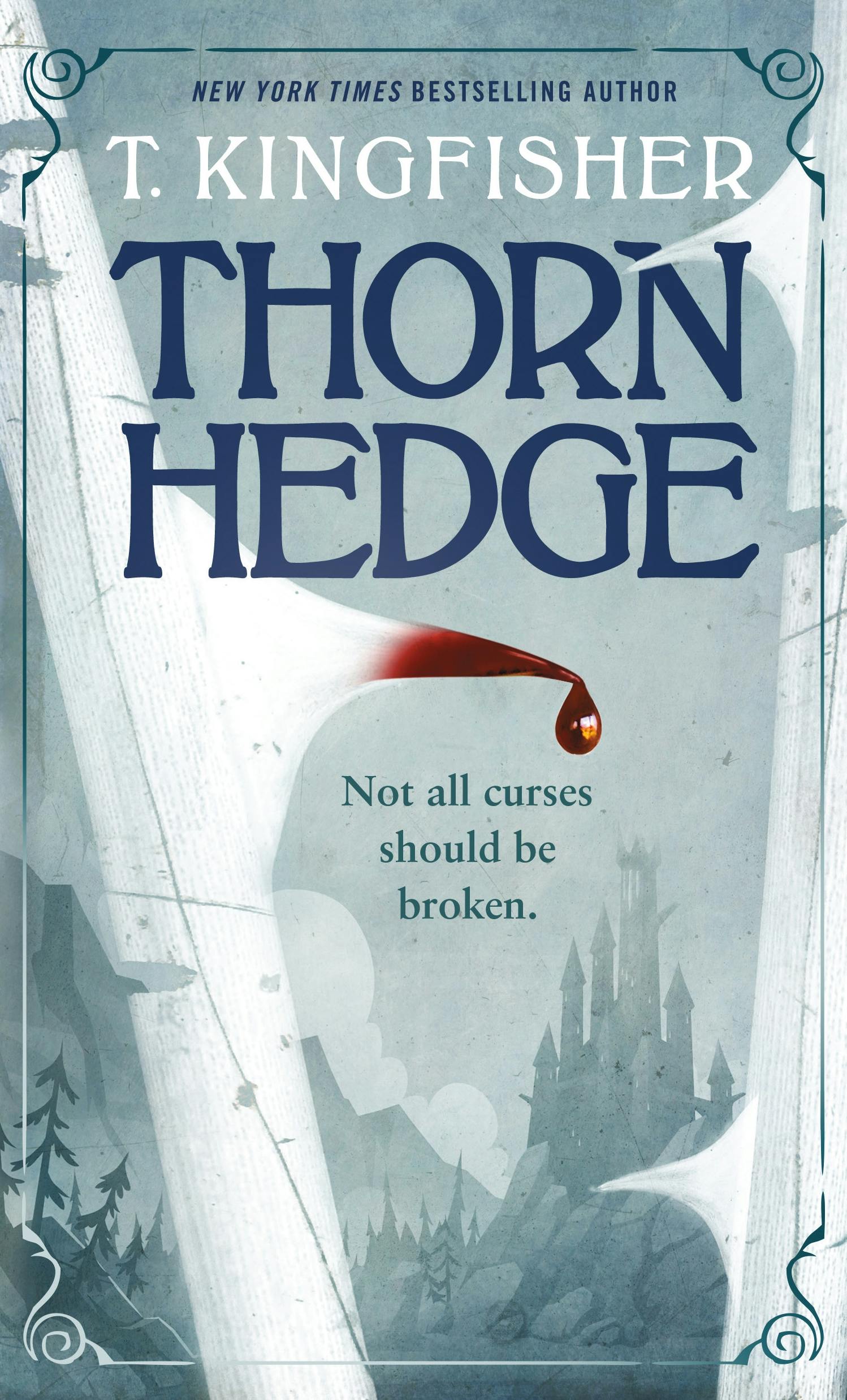
Fairy tale retellings are a dime a dozen, and, in fact, the medium of fairy and folk tales virtually demands retelling, embellishment, change. That doesn’t mean a retelling can’t feel fresh or fun, and T. Kingfisher’s Thornhedge is proof of that.
Toadling has no real name, but she has a duty, and a fairy-given ability to turn into a toad at will. The human snatched away to make room for a changeling, she nonetheless found a safe and loving clan of fairy to claim her, and longs to return to that home. Her duty, though, demands that she stay in the human realm. There, she uses her small amount of fairy magic to maintain the enchantment that put a princess to sleep and made a thick hedge of thorns grow around the tower that kept her. Years may mean little to someone accustomed to living in the fairy realm, but a couple of centuries means a lot of change for the humans around her. Toadling is relieved when the story of the sleeping princess passes out of memory, as visiting heroes make maintaining the enchantment more difficult.
Then, just as she thought the stories had all been forgotten, in rides a knight. A younger son of a nobleman and one poorly suited for war and sparring, Halim discovers the story of the sleeping princess in a dusty old book and sees rescuing her as a chance to do something noble that doesn’t involve the shedding of blood. Toadling’s efforts to dissuade him only make him more curious about what and who is hidden up in the tower–and why. The last question proves the most important, and Toadling, unaccustomed to talking to others and especially being listened to, realizes she must tell this knight the whole story to keep him from breaking the spell. As a friendship buds between them, she begins to wonder if he could even help break the curse.
This is no story told from the point of view of the villain. Toadling’s magic might seem amazing to human eyes, but she’s only a pawn in a much bigger and more dangerous game being played in the great houses of fairy. Her job is initially just to enchant the changeling princess to not harm anyone, but botching the wording means Toadling is stuck babysitting an increasingly volatile child for years–and centuries–to come. Toadling herself stretches the bounds of how timid a main character can get away with being, but seeing her peek out of her shell a little is worth a little frustration at her extreme shyness at the outset.
Meanwhile, Halim is a welcome new shade of a heroic knight come to save the day. Able but reluctant to wield a sword, he prefers instead to study and listen–and apologize for every imposition and inconvenience. His affability is a soft foil to Toadling’s mousiness, and the friendship that grows between them feels utterly believable. At times, his willingness to instantly believe Toadling’s version of events is less believable, but the story as a whole is lovely enough to let that pass. So, too, is the somewhat rushed-feeling ending, though that could be on account of the whole book being just 128 pages long. The length means this is a sweet little fairy-tale snack with some substance to boot, and is a more than welcome addition to the library of fairy tale retellings.
 Ring Reads