
I’ll be up front with this: I’m not a sports person, per se. I didn’t come from a sports-watching family, nor did I marry into one. The fact that I don’t watch real sports, though, is not to say that I don’t like a good sports movie, or novel. The best sports narratives use athleticism as the backdrop and let the players have center stage. That’s precisely what Rita Bullwinkel’s done in her debut novel, Headshot.
Over the course of a weekend at Bob’s Boxing Palace in Reno, Nevada, eight teenage girls compete for the Daughters of America Cup. That’s it. That’s the setup, and the plot. Yet that plot is really a platform for an exploration of character of these eight boxers. As Andi and Artemis face off, Andi thinks about the boy who drowned at the pool where she lifeguards while Artemis focuses on continuing her family’s legacy at dominating the ring. As Kate and Rachel fight, Kate recites the digits of pi to stay in the zone even as Rachel does her best to throw Kate off guard. The fight between cousins Izzy and Iggy weaves family history and drama into their exchange of punches. Rose and Tanya’s round is laden heavy with thoughts of sisterhood and their personal family traumas.
And then, of course, it’s on to the semi-finals.
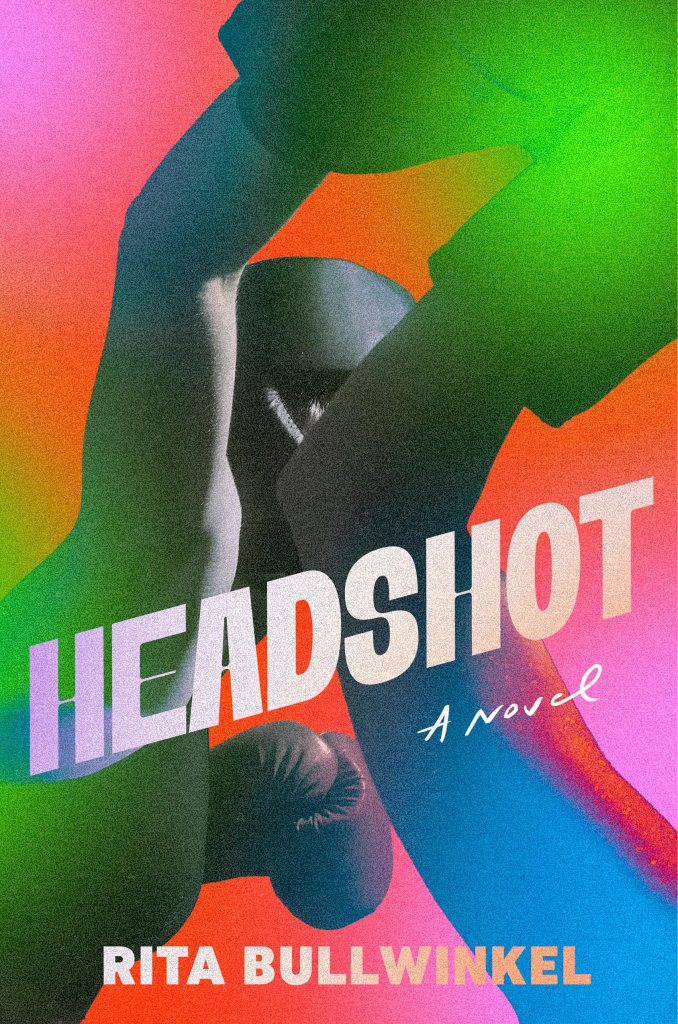
This is a slim book and it moves fast, with many sections coming and going as fast as a punch or a jab. Within those short sections, Bullwinkle manages to excavate deeply into many of the girls’ backgrounds, longings, reasons for fighting, and even how their attempt at competitive boxing ripples into their future. It’s okay to know that one boxer will become a grocery store manager and another boxer’s injuries will prevent her from holding a teacup by the time she’s sixty; within a round of boxing, past and present and future all collide into a single mesmerizing point in time. The stakes for each fighter feel enormous in that moment, and it’s almost impossible to tell who will win a match until the rounds are all over. More remarkably, most of those stakes are drawn from the most ordinary of things, which gives the world inside the book more authenticity and the world outside it a reminder of its import.
I’m not usually the kind of person to be precious about spoilers, but I was militant about keeping myself from accidentally seeing who won before I reached the end, just so I could stay present in the process instead of looking forward to the ultimate victory of one girl and the loss of seven others. The stakes, fatigue, and injuries only increase as the tournament proceeds from quarter finals to the semis and finally the prize-winning round, all of it drawn in sparse lines that are nonetheless vivid enough to make you almost smell the sweat. Up to that ultimate point, I found Headshot to be a near-perfect novel, one that had me pushing it on every remotely-bookish person who crossed my path. Maybe that’s why I found the final fight so disappointing.
The thing about Headshot is it isn’t a real boxing match. No one’s betting on this. We don’t need to fast-forward to the winner. It’s likewise not the kind of narrative where there are heroes and villains. There are barely rivals in this clash of fighters who are almost all strangers to each other. So I, at least, didn’t find myself rooting for one fighter or another. Bullwinkel makes them all interesting enough to merit our attention as long as they’re at Bob’s Boxing Palace. But since there is such a focus on character, it seems odd that we’d suddenly zoom out from those characters in favor of a quick summary, barely more than a play by play, that gives us the winner in four short pages–and from the POV of someone outside the ring, no less–feels like the opposite of a sports-movie climax.
I’ve puzzled over this narrative choice since finishing the book. Did Bullwinkel feel she’d shared everything about the final two fighters that there was to say? Was she looking for that different approach to make this fight stand out from the rest? I honestly would love to know; it might make me feel a little more charitably about those four little pages. Still, Headshot is overall a fantastic work of character-driven fiction, the kind that makes you stop and consider the mundane and exceptional alike in your own life as if they were suddenly turned profound on the page. I’ll likely keep feeling cheated out of a longer and more meaningful ending, but I also know Headshot will linger with me in all kinds of positive ways, too.
 Ring Reads