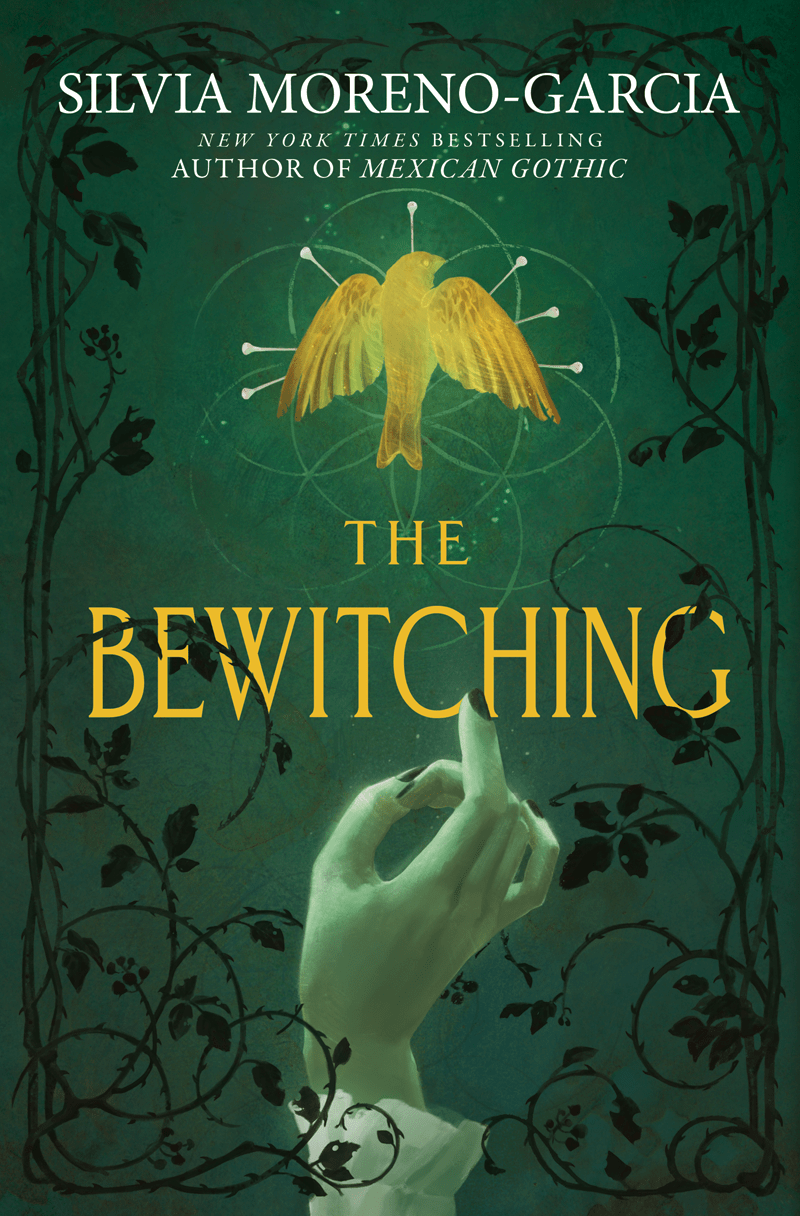
Silvia Moreno-Garcia has always been a versatile writer, with just about every genre appearing in her catalogue at this point. I’ve liked many of her books, and appreciated the skill of the rest even if the story or genre didn’t strike me dead center. Her latest novel, The Bewitching, however, feels like a leveling up in both story complexity and craft.
In 1998, Minerva is floundering at her New England graduate program. Her thesis is on the story behind a niche but foundational horror writer’s most popular work means uncovering the truth of a student’s disappearance in the 1930s—something much easier said than done, especially since the elderly woman in possession of the late author’s papers won’t return Minerva’s calls. A chance meeting with the woman’s grandson, however, breathes new life into Minerva’s thesis, but the path it sets her down quickly frays her already-fragile mental health. The more she learns, too, the more she remembers the stories of her great-grandmother, Alba, about the witches that haunted the area around her small Mexican village during her youth.
In 1908, Alba is a young woman reeling from the death of her father, but also sensing new paths open up before her in the form of a suitor or two. Thoughts of romance are hard to cling to when strange and wicked things begin happening around home, ramping up to the disappearance of her brother. Alba’s mother and handsome young uncle dismiss her worries that some evil magic is afoot, but her neighbor believes and helps her find answers—even though doing so puts him in danger, too.
Meanwhile, Minerva’s exploration of those coveted author’s papers reveals Beatrice’s recollections of the fall of 1934, filled with fun and flirting and young love, and the dark underside of all three when Beatrice’s roommate goes missing just before Christmas. Beatrice is only at the fringe of her roommate’s haunting but still sees enough of her roommate’s descent into madness or something like it for Minerva, or the modern reader, to see disturbing similarities about these events in the thick of the Great Depression and the ones that follow grandmother and granddaughter decades before and after that fateful semester.

It can be tricky for an author to create distinction among characters when each has their own point of view, especially when it’s the same person writing all three. Here, though, I felt a clear difference between Minerva, Alba, and Beatrice’s chapters and voices, a strength that held up even at the end when those POVs blurred. The mystery element is strong throughout in all three women’s stories, and although I only guessed at one of the culprits, all of the answers felt logical, and even satisfying. The way that Minerva pursues those answers, like her great-grandmother before her, is tenacious without stretching the bounds of credibility.
Minerva is a likeable enough character, but Moreno-Garcia, never one to shy away from making her characters, particularly her female ones, a bit prickly, lets us see and feel the strain of not just the mystery but academia in general on our main character. Alba sometimes requires patience in a different way, displaying the kind of fancies and foolishness many of us have to grow out of sooner or later. Poor naive Alba was, for me, the weakest element of the book until well past the halfway mark, when she did finally show us perhaps why Minerva revered her so. Still, in allowing these characters to each be themselves, rather than heroic facsimiles thereof, The Bewitching takes on a more authentic feel, even with its witches and ghosts and curses.
Moreno-Garcia also manages to tread a fine line with those fantastical elements. We sign up for witches, assume curses come with the territory, but the few ghosts slipped into the pages are subtle, though important, elements that Moreno-Garcia wisely doesn’t belabor. All in all, The Bewitching expertly weaves the supernatural and the pedestrian together across generations into something rich and haunting in all the best ways.
 Ring Reads