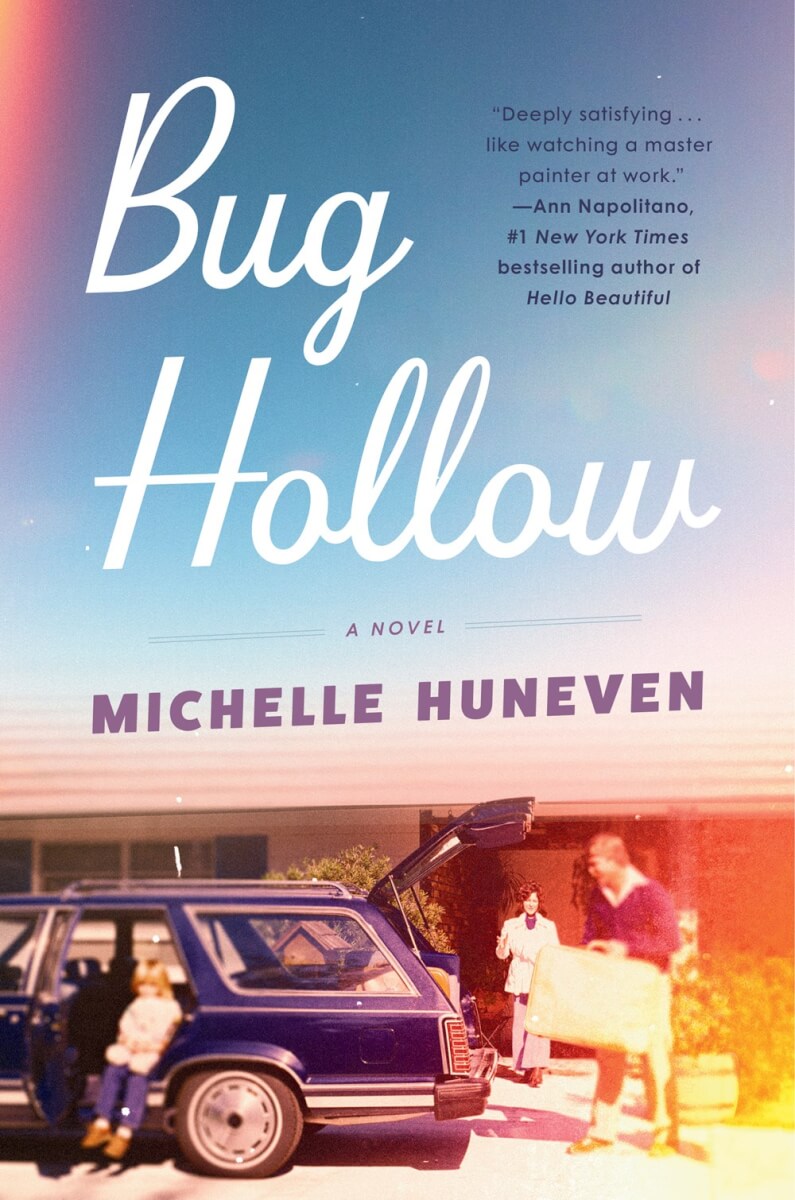
Michelle Huneven’s Search was a surprise hit for me a couple of years ago, especially given how lukewarm I felt in the moment reading it. And despite how judgmental I felt while reading it, the story, and characters, stuck with me. When I saw Huneven had come out with a new novel, Bug Hollow, I had to check it out.
Bug Hollow begins with eight-year-old Sally, whose brother, Ellis, has gone camping the summer after high school graduation and not come home. But he’s not missing—no, he’s just decided on a whim to spend the summer there. As soon as Sally’s parents (or, rather, her mother) finds out just where “there” is, they rush up to drag him home. In the titular Bug Hollow, Sally is in awe of Ellis’s girlfriend and the boho, artistic life the two are pursuing. Sally’s parents (or, again, mother) is less impressed. With some negotiation, they convince Ellis to return home for the week before he leaves for college. And a few weeks after Ellis goes to college, he is killed in a swimming accident.
His death, lumped forever with his summer-long disappearance, is the catalyst for the story to come that follows his family for the next thirty years. Julie comes and goes with his unborn child, who is then raised by his parents, Sib and Phil. A new young child in the house curtails Phil’s international business travel. Sib’s second-act career as an honors student teacher is marred by her growing alcoholism, worsened by Ellis’s death. Meanwhile the family’s middle child, Katie, finds that moving across the country isn’t enough space to simplify the difficult relationship she has with her mother. In the wake of time marching on and yet more change for the little family, partners come and go, relationships wax and wane, and always Ellis’s death marks an impenetrable border between “before” and “now.”

Huneven’s prose is light and fast-moving, though don’t think that means it can’t pack an emotional punch. Her observations both of and from her characters and the people around them are sharp and feel authentic. It’s easy to draw heroes and villains from the members of this family, and easiest of all with the sharp-tongued Sib and easygoing Phil. But, of course, nuance is more interesting than caricatures, and Huneven takes advantage of this multi-POV book to flesh each character out and given them plenty of shades of gray with little narrative judgement.
I’ve written before about how knowing a little of the making of a story can change how it hits, and that was unexpectedly true of Bug Hollow. I’m a sucker for multiple POVs, and for books of interconnected short stories. Despite its disparate POVs and each chapter jumping forward, semi-linearly, in time, this is considered a novel, not a collection of related stories, though it doesn’t have the kind of overarching plot most novels do. In Huneven’s acknowledgements, she mentions the creative writing class she teaches and their willingness to humor her writing prompts—and then notes that this book is a result of participating in those prompts herself. Given how many writers teach writing at some level, a book not influenced by its author’s teaching experience is probably in the minority. Knowing that these stories were generated by writing prompts and then strung together like pricey Middle-Eastern pearls, however, does make more sense than trying to intuit some grand scheme of authorial intent. In particular, a chapter about a minor character’s love life or lack thereof is much easier explained this way than as an essential building block of a broader narrative.
While I suppose it doesn’t matter in the end, especially since I had enjoyed reading this book, knowing the source did sour the experience in retrospect. Publishing genres mean less to readers than they do to booksellers, but they do also establish expectations on the part of the reader, and it’s odd this is still sold as a holistic story when it seems accepting its piecemeal nature would be a neutral, if not positive, signal for prospective readers. All of this, though, is a discussion for another day. Bug Hollow might not read like a novel, but it’s a good work of fiction nonetheless.
 Ring Reads