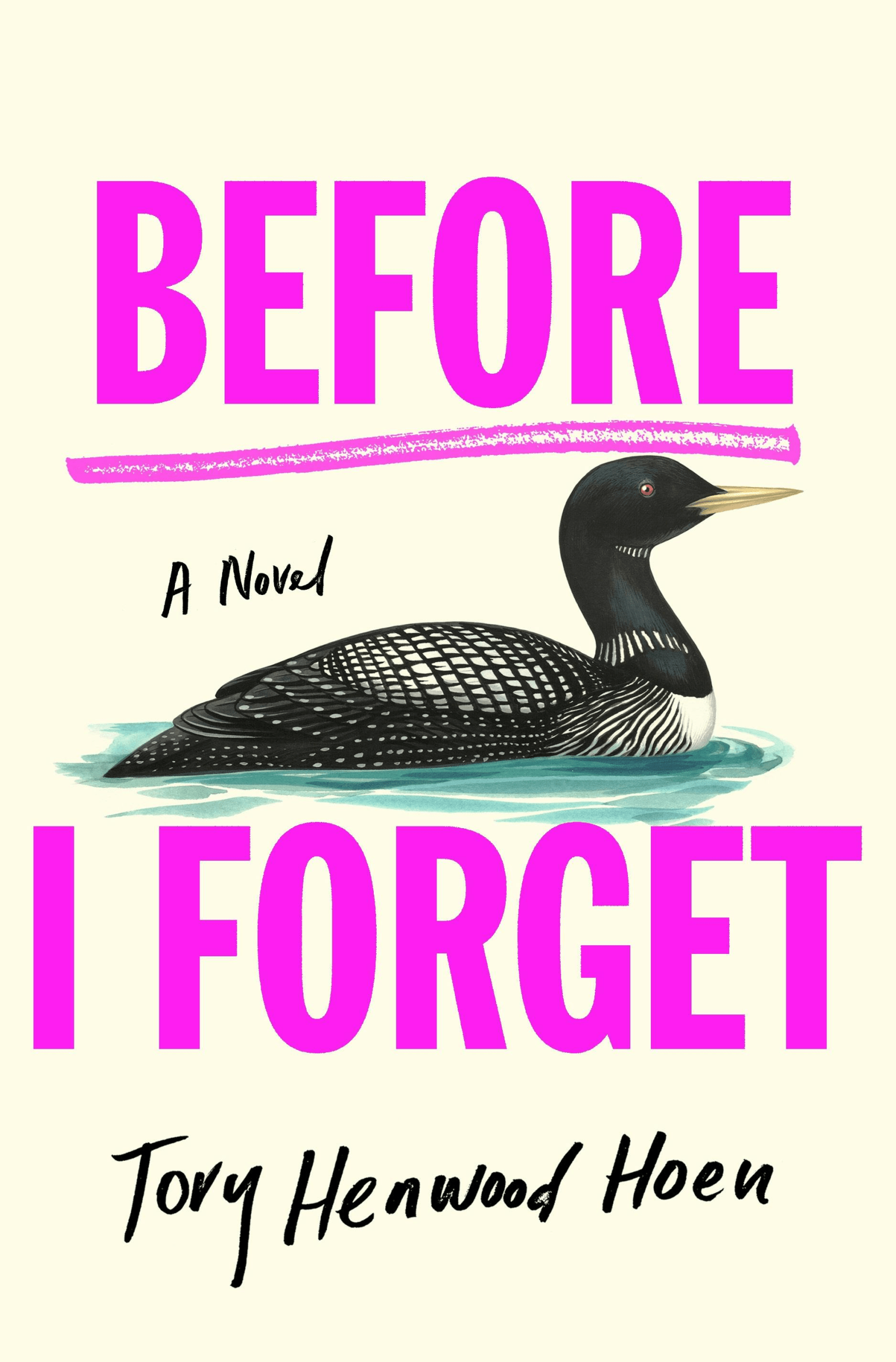
I’ve heard that, among many dementia patients, the past and present sort of collapse into each other—or the present completely falls away in places in favor of things from years or decades ago, much like ghosts still haunting a place long after it’s been torn down or repurposed. Forgetfulness and ghosts of the past (and present) also flatten together in Before I Forget, the latest from Tory Henwood Hoen.
Cricket returns to her sometimes-hometown in the Adirondacks to help her sister, Nina, find a nursing home for their father, Arthur. Nina’s been taking on the full load of his care since his Alzheimer’s diagnosis five years ago, but now Nina has an opportunity for post-doc work in Sweden she can’t pass up. And who else is going to care for their father, Cricket? It’s not long after returning from that surreal weekend of familiar sights and sad new realities that Cricket realizes that, yes, she does want to uproot her life as a listless twenty-something in New York City to be with her father in the end. So, Nina leaves and Cricket moves in, only pretty sure she’s up to the task.
Being back has some challenges she anticipated—reacquainting herself with a father she hasn’t had a meaningful conversation with in a decade and who now barely remembers her name, for example—but others she didn’t. Her old haunts are full of imagined ghosts, chief among them Seth, her first love who died in a tragic accident when they were teenagers. For Arthur, though, those ghosts might just be real. He sees Seth, but he also sees the loved ones of his neighbors and friends. For many, those ghosts, and the shockingly lucid insights her father spouts off even in the midst of confusion, are a source of comfort. Cricket wonders if Arthur, in the place of his memory and sense of self, has gained the powers of an oracle. Whether he can give her a sense of closure, for his impending death or Seth’s decade-old one, is another question altogether.
Before I Forget is a sweet, swift read that focuses on the emotions surrounding memory and self, though it shies away from some of the gnarlier aspects of giving care to a dementia patient or otherwise afflicted elderly parent. Arthur’s forgetfulness is a gentle one, heartbreaking in his loss of connection with his daughters, but comforting in the patient and wise man that persists even when his past is gone. He slows down during the course of the book, but his decline is in the periphery. That is, until it’s not. Still, it’s a far more pleasant picture of the end of a parent’s life, though the omission of those more difficult parts seems deliberate on the part of Cricket, who is choosing to tell the story of this last chapter in her father’s life (and a middle chapter in hers) in this lovely and sometimes dreamlike way.
Cricket may be in her late twenties and with a decade of big-city living under her belt, but in many ways she’s never left the Adirondacks, just like she’s never regained the hope or certainty she felt as a teenager. This is a coming-of-age story for her, and a revisiting of what might be called her first coming-of-age story the summer she met Seth. A little age and experience can make even pivotal events look a lot different, though for Cricket, most of the new insight she gets is from others—either those who were in her orbit at the time, or new friends pointing out truths she’s missed for a decade. It’s common for many people to look back as they near the end of their first decade of adulthood and wonder how they ended up here, how they’ve kept or disconnected from the person they used to be. Most of us, though, don’t do so with such guilt and grief marking the start of that span.
Before I Forget is, too, a race against time. Arthur’s capacity, even limited as it is at the start of the book, won’t last forever, and Cricket’s focused enough on her meager funds she might as well be hearing a tick-tick-tick coming from her banking app. Time is running out to reconnect with her father in whatever way that looks like now. Likewise, it seems the end of her time in the Adirondacks will also mark the end of any opportunity to find some resolution to the unanswered questions from her teenage years.
While the aforementioned glossing over some of the more difficult parts of caretaking did threaten my suspension of disbelief, 2025’s been rough, man. It’s been rough for a lot of people in a lot of ways, and even surviving it in relative comfort and stability has been taxing. In a year where I’m legitimately afraid that my nice, hardworking, and fully legal neighbors will be dragged out of their homes and disappeared, I can appreciate wanting to frame things a little more gently. I can appreciate a story where characters make friends and heal old wounds and things work out improbably well. Not all tragedy can be avoided, but sometimes it can be blunted or given a silver lining, and that’s nice.
 Ring Reads