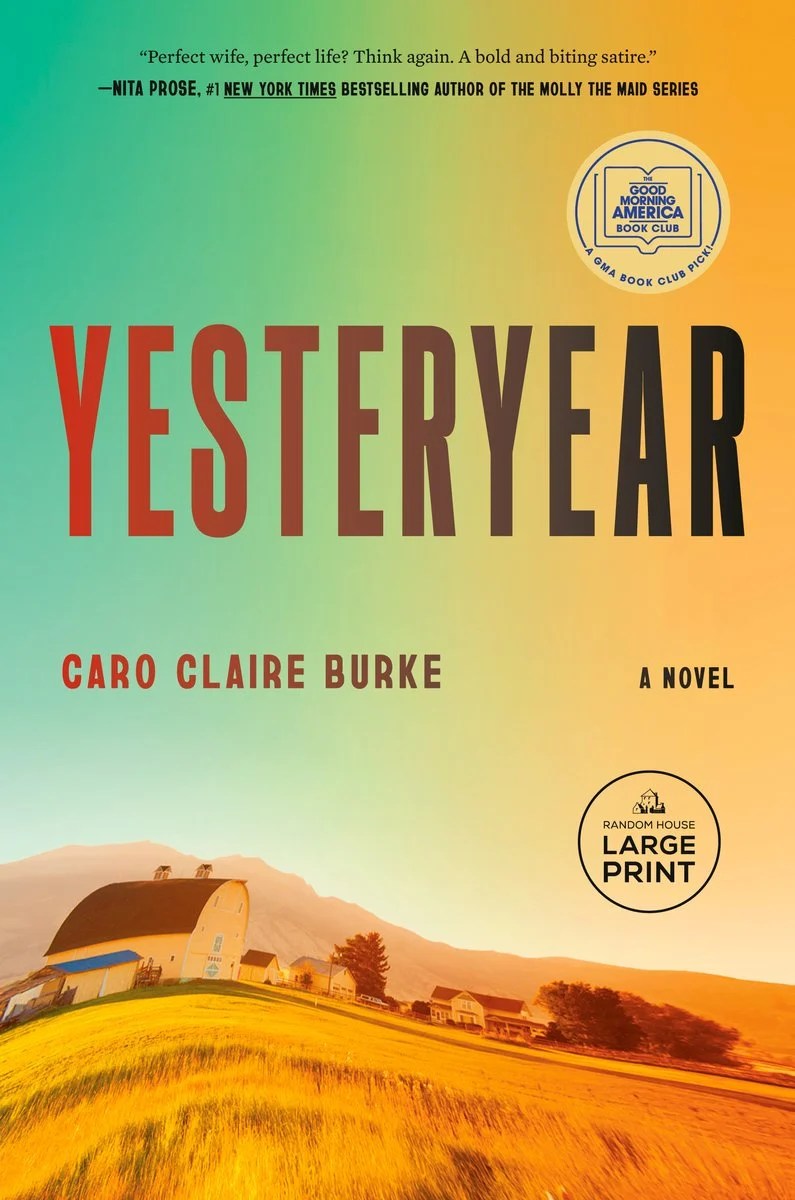
The tradwife influencer has become a force in the last few years, and though the ideas of a woman’s place being in the kitchen is hardly new, social media has given a flashy new veneer to the carefully orchestrated perfectionism all women should aspire to and all men should demand. It’s always seemed obvious that the unrealistic standards, and the apparent ease with which influencers raise a family and cook everything from scratch and run a house or a homestead would come with no small amount of stress. But just what that stress might look like, and how a basically normal person might sink into the kind of radicalism that tends to accompany these influencers, is detailed in alluring and sometimes alarming detail in Caro Claire Burke’s debut, Yesteryear.
Natalie’s picture-perfect life on her Idaho ranch has made her a viral presence online (but don’t call her a tradwife influencer). Behind the scenes, of course, keeping up on that perfect life requires two nannies, a producer, and a fleet of farm hands, but the millions who follow her don’t need to know that. Just as it seems nothing can stop her rise, she finds herself thrust seemingly back in time to a homestead that is really a homestead, where bread actually has to be made from scratch and the family’s survival really is connected to the continued happiness of their flock of chickens. The family there is different, too: her children seem familiar, but have different names than the children she remembers, and her sweet but dim husband is sharper and meaner.
As Natalie tries to figure a way out of the accurate homestead and back to her idealized one, she reflects on how she got to that influencer life in the first place. From meeting and marrying her husband young to trying to find a calling that suited them both to the pressures of her far-right political-candidate father-in-law, it soon becomes clear that becoming an influencer was less an accident than the result of a series of improbable but desperate leaps out of the proverbial frying pan and into the fire. Any casualties along the way, including Natalie’s family of origin or the comfort of her children, is only collateral damage in her continuous effort to stave off worse outcomes. At least, that’s how she sees it.
Natalie is clearly an unreliable narrator from the jump, though the level to which I felt Natalie could be trusted did wane over time. The cracks in her perfect life are wide enough for light to shine through. It’s hard to tell if Natalie’s growing abrasiveness is self-righteousness from her growing fame or the result of her being pushed into a tighter and tighter corner by her financial, familial, and fan-based pressures. Seeing her sink deeper into her online perfection while maintaining her fixation on what the feminists from her former life must think of her—the “angry women” in her past and in her comments section—is ugly but fascinating, a real train wreck that our voyeurism in makes us equal to. In delving into this part of Natalie’s psyche, Burke walks a fine line between psychological exploration and parody, but manages that balance well.
The reality of Natalie’s life in the hard-scrabble homestead was harder to parse, and harder to connect with, particularly when she accepts her lot as a bizarre part of God’s plan for her. In the beginning, she’s desperately trying to find her way back to her timeline, her life. As events unfold, a switch flips, and she decides to embrace this strange and awful life instead. Doing so isn’t entirely outside of her character, but it does make it harder for those chapters to feel like they’ve got the same momentum as the surrounding plot. This is a minor gripe and could easily be overlooked if the resolution of this plotline felt more authentic to the story surrounding it.
There’s no way to give specifics without some considerable spoilage of that reveal, but for this reader, the events leading up to her apparent travel through time, and the choices she made as a result, did not feel like they belonged in the context of the rest of the world Burke created. The reveal is ironic, to be sure, and what follows isn’t entirely out of character for the story or the people in it. However, it does feel more a device of convenience than a logical set of events. While the ending is a comparatively small portion of the overall book, it has the misfortune to be the last thing a reader takes with them. If it feels false, it’s tough for that sensation not to taint the rest of the work.
I have a feeling sales of Yesteryear and the popularity of the forthcoming Amazon adaptation will prove me wrong, and that’s okay. Not everything is for everybody. After all, as Natalie knows all too well, there will always be angry women no matter what you do.

