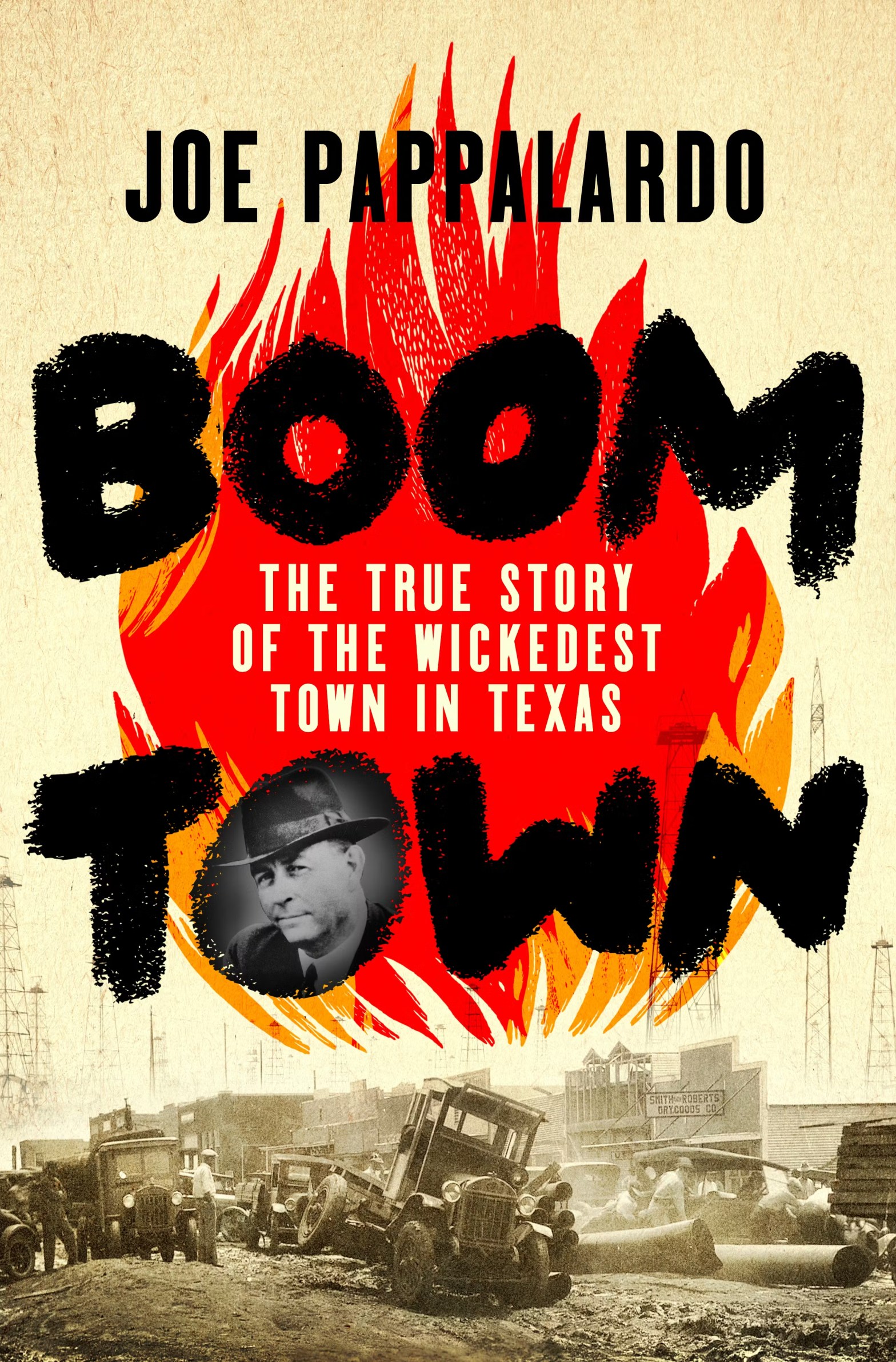
It’s a sad fact that some of the most interesting stories in life will happen and fade from memory in a generation or less, vanishing from the historical record forever. In Boomtown: The True Story of the Wickedest Town in the Texas, Joe Pappalardo mines a months-long spate of happenings in a small, brand-new Texas town a century ago for a propulsive, if dizzying, book of how the headlines unfolded.
In 1926, a new town was put on the map. Borger, Texas, was established to support the booming oil industry, and the people who worked in it. Houses and businesses cropped up where there had been only rolling scrub, and people bought into the ambitious promise of a modern community with plumbing and more than its share of riches from the surrounding oil fields. Of course, no town is immune from a little rabble-rousing. And in Prohibition Texas, you’re bound to have some gin-running. Whether Borger had more than its share of riches is debatable, but it certainly had that lion’s share in trouble. Within a year of its founding, it had the dubious title of the “wickedest town in the state.”
That reputation might have come from all the murder, mostly associated with bootlegging. Or, it could have come from the corruption within the city government and local law enforcement. Maybe it was from the attention around, and challengers against, Borger’s own boxing champion. Maybe it came from the prostitution, or the fires that would break out in poorly fitted oil pumps. Whether from a single dark event or the combination of crimes and characters in this boom town, from February through August 1927, Borger hurtled toward lawlessness, and the appearance of Texas Rangers to tame this frontier town stoked as many fires as they quelled.
Pappalardo took on quite a project in trying to tell the story of Borger’s hectic year, particularly his dedication to weaving together so many threads rather than focusing on a single character or sector. The boxer gets the same kind of screen time, so to speak, as the fireman, as the mayor, as the Texas Rangers, as the sheriff. I read Boomtown as an ebook, but a physical book might be a better choice here for easier reference to the large cast of characters, especially in the beginning. A physical copy would also likely be a little easier for flipping back and forth with Pappalardo’s wealth of sources.
I appreciate a well-sourced history, and Boomtown has receipts, mostly from contemporary and local newspapers and other contemporary sources. While some of the dialogue is more exact than the actual historical record allows, Pappalardo is transparent with this creative license, and gives plenty of footnotes to support his invention. It’s fascinating to see the lode of compelling drama, both of the small-town variety and the kind that would hit headlines no matter where it happened, that he’s not only found but brought to life.
As I mentioned, the number of characters and storylines is at times dizzying, but another challenge is Pappalardo’s choice to write Boomtown in present tense, rather than past tense. On the one hand, the immediacy of present tense does bring the reader along as though the story is unfolding before our very eyes, and it’s a compelling to see each real-life plot develop in that way. On the other, present-tense narrative is a Choice even in fiction, and one of the reasons it’s rarely used in historical writing is because of how tricky it can make giving context. For the most part, Pappalardo deftly avoids potential missteps, though there are a few sentences that hung me up upon first read.
Boomtown ends still in the thick of many of its issues, though the trial that becomes central as the book progresses has been wrapped up. It feels abrupt in some ways, as does the end of the final chapter that shows us Borger two years in the future. This is the real challenge of writing real history, even very well sourced history: at a certain point, real life is going to stop moving at the pace of a good story, and the various little dramas rarely cooperate by wrapping up at the same time. It’s a challenge that no amount of craft in writing or research can always defeat. Still, it seems only fair that the people of Borger get a break at some point, even if that break comes at the cost of a more explosive story.

