Listen, I like some good prose. I appreciate when an author tries something new to tell a story a different way. I am a sucker for polyphonic stories and love seeing a situation from radically different points of view. The thing about those qualities, though, is that sometimes they distract the author, and often the reader, from what the story is trying to say beneath it all. And that, I fear, is the case with Maxim Loskutoff’s novel Old King.
At twenty-nine, Duane didn’t expect to be breaking into his own home to steal the microwave he gave to his wife. But if he’s going to get pushed out of his home and marriage, he figures, he can at least take the one luxury item he got her. (Hey, it’s 1976, and it’s a good microwave.) Driving aimlessly, he winds up in the tiny town of Lincoln, Montana, and decides to stay, for now. “For now” turns into several years, during which time he moves up from sleeping in his truck to living in a small cabin he builds with his own two hands. He builds relationships, including with a local waitress and appreciative microwave-user, Jackie, and his odd “next-door” neighbor, Ted.
Of course, Ted—that is, Ted Kaczynski—has oddities beyond peeping on people through the scope of his rifle or, uh, producing his own fertilizer. His jaunts away from his cabin allow him to sabotage equipment from a nearby logging operation, while his trips out of town are necessary for him to mail the packages that would eventually bring him explosive infamy. As the years pass and Ted’s bombs frighten, maim, or kill more and more people, life in remote Lincoln inches closer to modernity.
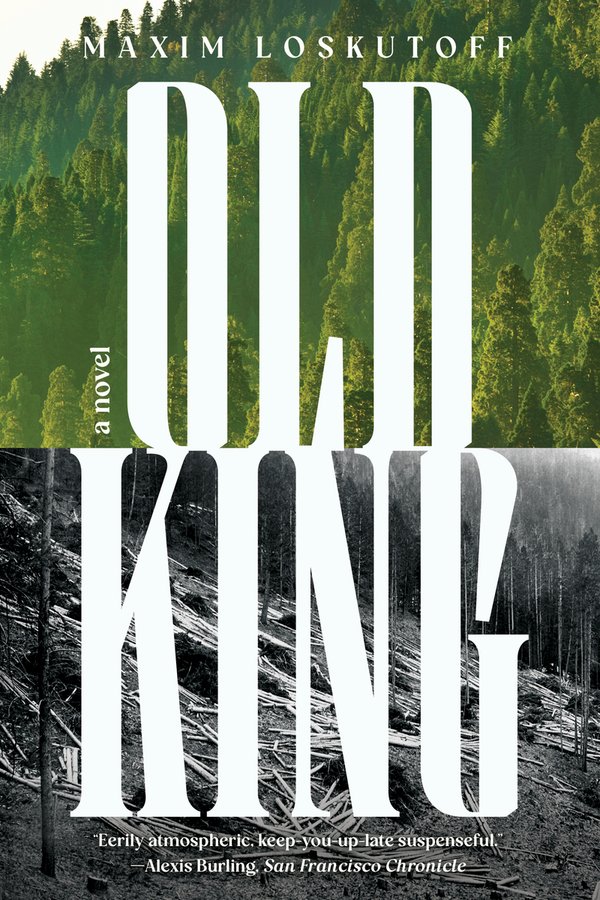
This is no exploration into the early days of Kaczynski’s crimes, no imagining what truly made the Unibomber. Loskutoff’s exploration, rather, seems to be in the tension between nature and modernity that drove Kaczynski. Duane finds seasonal work with the logging industry, though he has to admit that he might feel a certain way about how bare the mountains start looking after a long day of work if he let himself think about it. Jackie, a lifelong Lincoln resident, doesn’t see the point in either liking or disliking the changes; change is coming, no matter what. Mason, Jackie’s ex who works for the Forest Service, has shed the development-happy mindset he earned in his days as a preppy East Coaster-er, though he quickly learns that conservation brings its own challenges. And, of course, there’s Ted, enraged by the noise and the people he came all this way to escape.
Of these character arcs within Old King, Mason’s is by far the strongest. His dedication to practice gentleness on even the fiercest creatures and use his limited power to its fullest extent feel like a bid for redemption against the privilege and carelessness he was born into. That gentleness doesn’t always extend to people, particularly those he sees as chronic threats to the flora and fauna in the forest he’s charged with protecting. He holds fast to this new and deepening philosophy even when it alienates his few allies in town. When a camper is killed and the signs point toward a previous patient of Mason’s wildlife rehabilitation efforts, however, he has to grapple with the reality of what really happens when people and the wilderness combine. He’s a character full of flaws and an equal amount of determination to do better, making him a compelling character with a compelling story.
The other characters get less tidy arcs than Mason. The book starts with Duane, but his story feels unfinished and undefined by the last time we see him. Jackie’s few POV chapters give us her perspective but no opportunity for growth. Nep, a postal inspector on the case of these mysterious bombs being mailed around the country, brings insight into the long and frustrating investigation into these baffling attacks, but little else. Most disappointingly, Ted, a purported central figure to this book, if the back-cover copy is to be believed, is perhaps the most static of all. He begins the book angry and determined; he ends the book angry and determined (and far from being caught). It’s hard to tell whether this Ted is built from the perusal of his Wikipedia page or more extensive research, and there’s no author’s note or acknowledgements section to give insight into that part of Loskutoff’s writing process. Regardless, there seems to be little attempt to make Ted a multi-faceted character, and this seems like a real missed opportunity.
I’ve written before about how interesting complex and believable villains can be, and how important it is that we see evil in otherwise ordinary people rather than just the mustache-twirlers and puppy-kickers among us. Anyone who hears about a man who rigs bombs against innocent people in an effort to spread some anti-technology message is going to assume that man is a bad person. This does not take an award-winning author to tease out of news reports. What’s more interesting, more unexpected, and perhaps more difficult, is understanding that man enough to imagine the steps that took him from someone who basically exists in polite society to the hermit blowing up universities and computer stores and airplanes. There may be an argument against the appropriateness of championing that bad person’s violent dogma, but what about understanding what can drive a man to become that bad person? That is what I expected, and wanted, from Old King. But, like many of Kaczynski’s bombs, it missed its target.

