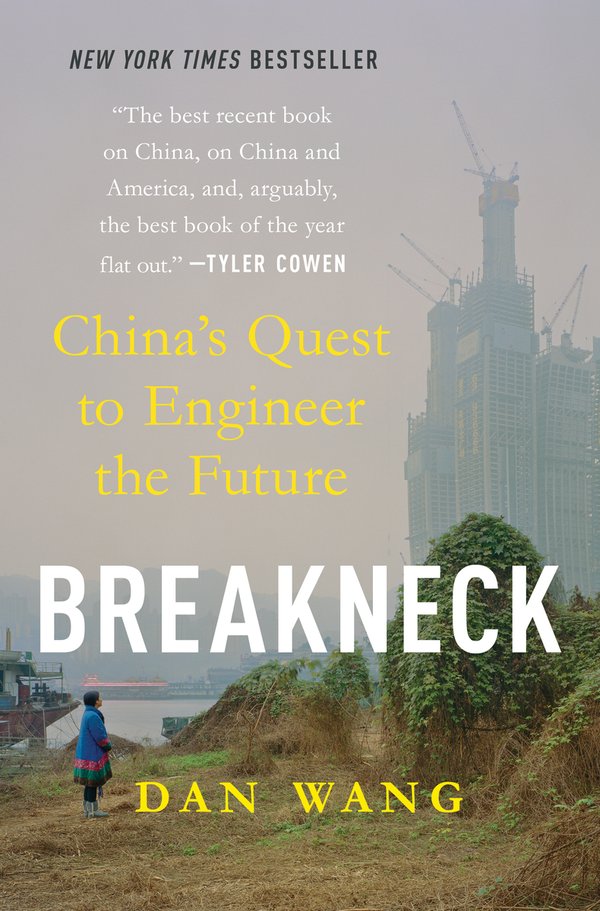
As the casual news reader from any point this millennium might have noticed, politicians in the U.S. are obsessed with the threat to global dominance perceived from China, and apparently Chinese officials are equally obsessed with besting the U.S. at long last. According to tech analyst Dan Wang, however, both outcomes are possible, but neither is likely for a multitude of reasons he hammers out in Breakneck: China’s Quest to Engineer the Future.
In Breakneck, Wang outlines the growth that have made both China and the U.S. major global players, as well as parts of their past and present that could be hindrances to future dominance. At the same time, his experiences emigrating as a child from China to the U.S. and living periodically in both countries as an adult—including, crucially, during the COVID-19 pandemic lockdowns—lend both on-the-ground credence and opportunity for personal reflection that breaks up his high-level analyses. China’s relentless quest for dominance has led it to perfect and embrace an attitude of engineering its way through all challenges, an approach that Wang argues is the poster child for “too much of a good thing.” Meanwhile, the U.S. rose to its position as a global superpower in large part because of its relentless and efficient growth—growth it outsourced decades ago, Wang writes, and in place of that manufacturing capability has leaned into becoming a nation of lawyers.
Lest you think Wang’s criticism of the U.S.’s shift in commercial focus is aimed toward the red or the blue, Wang’s got pointed thoughts about each. Trump, in both terms, Wang writes, has been a torpedo for personal and corporate interest, while Biden largely postured for four years. More broadly, Democrats, he argues, have regulated the country into a stranglehold, while Republicans have seemingly made it a perverse mission to tear down government for being too onerous rather than incentivizing public works projects. (Presumably, Wang is not inviting the reduction or elimination of barriers protecting water supply or bad-faith projects like sneaky data centers.)
To this point, Wang does call out Elon Musk’s DOGE effort, which could have reduced the amount of red tape in key segments of government. Wang was, it should be noted, writing this in early 2025 when Musk was only boasting of his plans, so Breakneck can’t comment on what was actually achieved in that chainsaw-wielding effort, but he did correctly anticipate that smart and informed cuts to government process were unlikely be a priority for DOGE. Breakneck was only published last August, but certain parts already feel dated, thanks to the gleeful autopen in the White House and the proliferation of untethered generative AI in both nations. Other points feel timeless, like the lingering reverberations of Mao-era China and the U.S.’s bombastic insistence of correctness in all things.
Breakneck is best being read a chapter at a time. Sitting down with the book as a whole and trying to read it in a session or two gives the feeling of being cornered at a party by someone itching to rant about the wrongness of both the U.S. and China’s approach to growth and policy. That said, the rant is well researched and reasoned, and I’ve certainly had worse rants thrust upon me at parties. At least this one I went looking for. Wang’s relentless push to make his point does soften near the end, when he reflects on his family’s emigration to the U.S. when he was young, and on the opportunities and what-ifs that have come since. There’s a lot of promise to China, and a lot of reasons the massive country won’t live up to it anytime soon, he argues. There’s a lot of promise in the U.S., too, Wang says, and the likelihood of us remembering the best of ourselves, while perhaps unlikely in the current political climate, is high enough to be hopeful.
I didn’t expect an optimistic end to such a forceful book, and I especially didn’t expect some of that optimism to feel like a rebuke. But things being as they are, I’ll take it.

