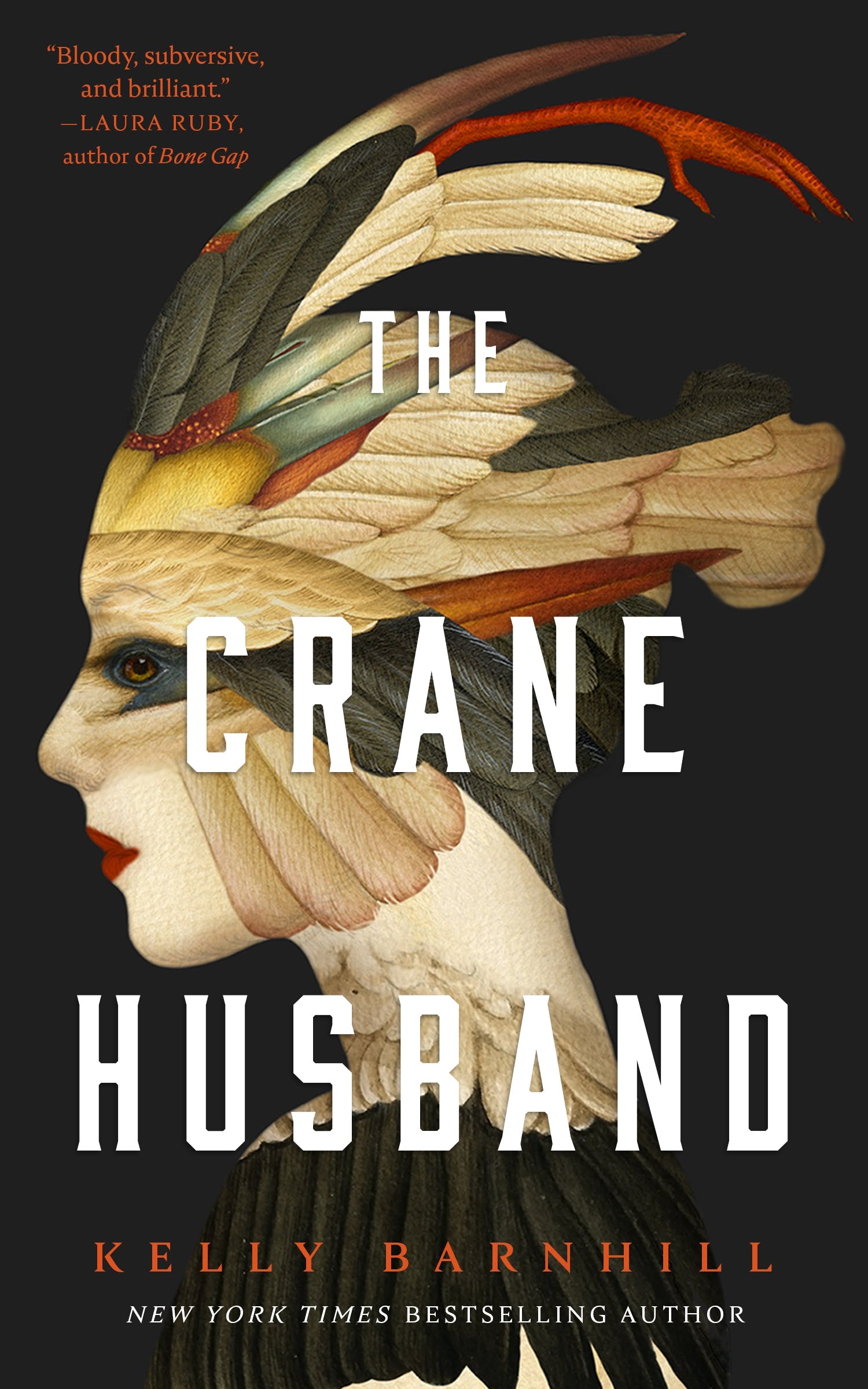
Passion is the key to ground-breaking art, we’re told, and every great artist needs a muse. In the Japanese folktale The Crane Wife, a magical crane repays kindness showed to her by transforming into a beautiful woman and reverting to her crane form only to weave incredible bolts of cloth for her poor new husband to sell at the market.
In an odd coincidence, this story came up last fall when I reviewed The Crane Wife by CJ Hauser, which used a version of the story as a lens through which to see their relationship crumbling in the runup to their long-awaited wedding. Hauser’s take is of a wife giving too much, including her art, for an oblivious and unreciprocating partner. Kelly Barnhill, on the other hand, flips the story and its typical moral on its head, weaving a tale instead of how passion and art—and love, or something like it—can tear the artist apart. And if there are children who need to be fed or cared for, you’d better hope one of them can fill in the gaps.
That’s the case with the fifteen-year-old narrator in The Crane Husband. Her mother has always been a brilliant but temperamental artist, and those less-flattering traits have only gotten worse since the death of her father six years before. Now, our narrator takes care of the family’s finances on what is left of a once-sprawling farm now eaten up by corporate monoculture. She cares for her twelve-year-old brother, too, shielded from the worst of the instability. But she can only do so much when her mother brings home a new lover.
Her mother has had lovers before, but none have stayed. None have brought the chaos the new one brings, either, and not just because he’s a crane. Nights are now filled with strange sounds, and her mother emerges in the morning exhilarated but sporting an array of strange injuries. Her mother insists everything is fine, despite mounting and overwhelming evidence to the contrary. Meanwhile, a social worker is asking too many questions about the siblings’ living situation at a time when the narrator’s mother is less capable of mothering than ever. The crane is the problem, but her mother can’t or won’t see his clear destruction of or distraction from the rest of the family’s world.
The all-consuming artistic passion from the narrator’s mother overrides every other desire, but shades of domestic abuse are the real art here. The crane may not target the children, but that doesn’t keep his presence from being a constant threat. No matter how fine the mother insists she is, her injuries are real and obvious. Things are broken or damaged. The mother works furiously on something, her biggest something yet, but it’s nothing that can be sold so that food can be bought. The neglect carries to the menagerie of animals on the little farm, and, yes, to the children. “Parentification,” like “gaslighting,” is a word that has been twisted enough by armchair psychologists that it has lost much of its meaning, but our narrator is a textbook example. Through her sacrifice, she ensures her not-much-younger brother can have a childhood, even if hers has been over for six years.
The Crane Husband is a short book, but it’s not an easy read. It is, however, a meditation on responsibility and art and what love actually means, and so beautifully written that even with material like this you may still feel that you could fly away when you reach the end.
 Ring Reads