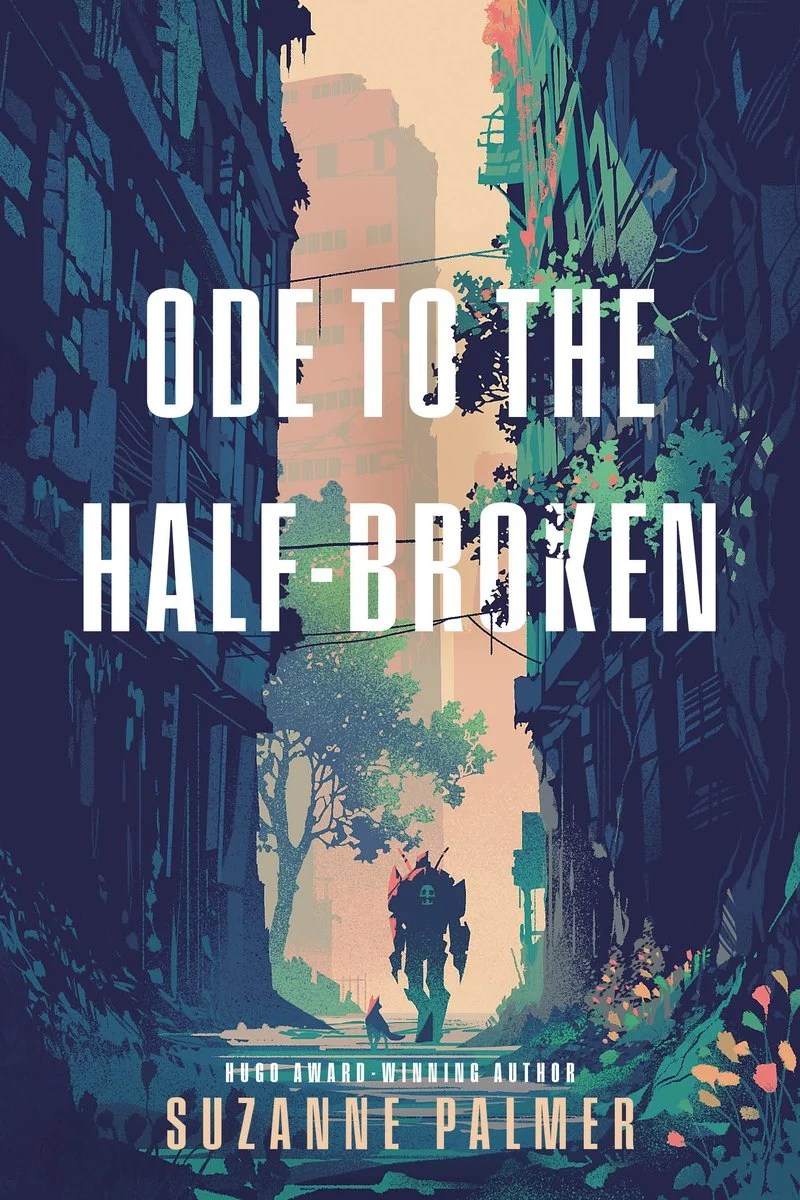
There’s something about the “survivor and their dog roam about a post-apocalyptic land” story that makes it an easy one to connect to. In Ode to the Half-Broken, the latest from Hugo-winner Suzanne Palmer, the survivor is a robot and their dog is a cyborg, and it’s just as relatable as anything Isaac Asimov or Peter Heller could dream up.
Be, a former war mech who has decided in the peace that has followed the near-apocalypse to be really into insects, comes back online in a bathtub, missing both a leg and all memory of how they got there. With the help of a cyborg dog named Atticus, they are able to patch themselves back together well enough to start searching for their missing leg. That search requires Be, who has studied their insects in self-imposed solitude, to see what the world has become in the thirty years since. Some things are a pleasant surprise, like how well mech- and humankind seem to be integrating in many communities. But there are also signs of something troubling brewing, like rising rates of illness and computer viruses alike. When Be finally catches up to their leg and its thieves, it’s apparent these mechs have had their programming scrambled in some quite insidious ways.
Although Be is used to being alone, they quickly become surrounded by a growing number of allies, including Atticus, an ace human mechanic, a helpful little drone, and even a repurposed train mech. Friends alone, however, won’t be enough to keep Be from having to face their past, or their siblings. Things only become riskier as old enemies from the war days rally their respective troops in an effort to make their side win once and for all. But perhaps the riskiest part of all is Be’s growing realization that thirty years of remaking themselves might not be enough to override their programming and revert to a state of being they fear and regret.
Few stories can get away with the main character waking up with no memory of how they got there. Half-Broken is a rare exception, aided by a computer going offline instead of an organic mind having convenient gaps. More challenging in the beginning is connecting with this mech, whose yearning to stay home feels more like ambivalence at first. But as Be interacts more with the world around them, it becomes easier to connect with Be; as Be shakes off the dust and finds ways to integrate who they were and who they are, it becomes easier for the reader to know Be, too. But even in the beginning, Be is less Bilbo Baggins tugged into adventure than they are a grizzled, reformed adventurer pressed into one last job.
Motley bands of adventurers are nothing new in genre fiction, but the one that surrounds Be feels comfortable more quickly than most. Atticus provides the running commentary that gives Half-Broken some comic relief (though it was one of Be’s deadpanned lines near the end that got me laughing), while the mechanic, Murphy, gives both us and Be broader context for how the world of the present really works.
In the acknowledgements, Palmer notes that writing this book came amidst significant personal change and loss, and that while Half-Broken might not be a book about grief, grief is a steady thread throughout its pages. Saying that in so many words is unnecessary for all but the most hapless reader. Be might have given up their old life willingly, but the peace of their new one doesn’t fully detach them from what they were made to do. Losing their home to violence they did not court is another blow, even if it is blunted with a new friend and mission. Atticus, too, has his new life risen from the ashes of his old one, ashes that can still burn if he’s not careful. Murphy’s ashes are literal; even Charp, the drone, has times it would rather not recall. But what once was doesn’t have to be what is or what will be, Be knows, and tells a character late into the story. For a book about grief, it’s a hopeful message that’s sorely needed.

