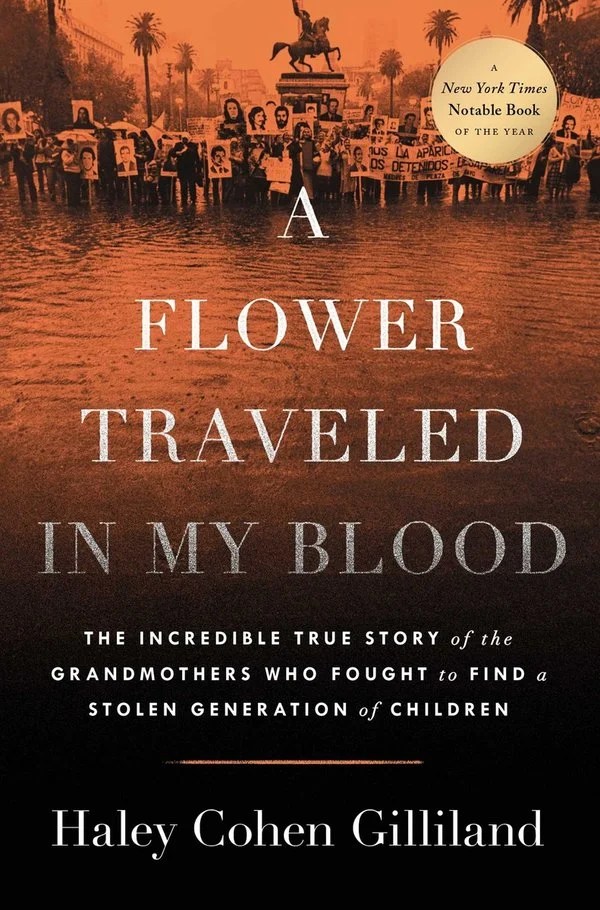
There’s real power in a well-written history, and in solid journalism. Any subject can be informative, but done right it can be compelling, emotional, and stirring, too. I got all that and more with Haley Cohen Gilliland’s debut, A Flower Traveled In My Blood: The Incredible True Story of the Grandmothers Who Fought to Find a Stolen Generation of Children.
In 1978, Rosa Roisinblat’s daughter and son-in-law were whisked away by military men from their home in a suburb of Buenos Aires. Their crime was being part of a group protesting against the military dictatorship that had led Argentina for the last two years. Patricia and Jose were only two of the nearly ten thousand young adults disappeared in Argentina during the late 1970s and early 1980s, the vast majority of whom would never return home. As Rosa tried to find Patricia and care for the toddler granddaughter left behind in the raid, she had another grandchild to worry about; Patricia had been pregnant and near to giving birth when she was taken. Rosa never found Patricia or Jose, but as she continued to search for answers and the grandson she hadn’t had a chance to meet, she found kinship with other women searching for their children and grandchildren.
In groups called the Madres and the Abuelas, older women demanded information about the disappeared, even after some of their founding members were disappeared themselves. As the regime changed and then changed again, the Madres and Abuelas not only sustained but increased their demand for answers. But in an age where calls for “moving forward” meant forgetting the sins of the past regimes, finding answers seemed as impossible as finding bodies. Science, though, can make up for a lot of lost or nonexistent records. Straightening out the complex emotional landscape of loss and love and justice and mercy is a little less straightforward.
Gilliland’s writing is straightforward and moves at a good clip, with enough context to have a grasp on the complexity of the political situation without getting too far into the weeds. While the prose and structure is a nice read, there’s no making this subject matter go down easy. I had only a cursory understanding of Argentina’s instability during those troubled decades. Flower has inspired me to learn more, but I’ll need some time to recover first. But then, nothing about Flower should go down easy. The degree of impunity with which the military acted, and the foot-dragging it took to get a comparative slap on the wrist for those involved, should be hard for anyone to grapple with. The horrors of forced family separation, rampant human rights violations, and elusive justice should never go down easy.
Wisely, Gilliland chose to attack this sprawling and difficult story through the lens of a few families, chief among them Rosa’s. The matriarch’s seemingly inexhaustible quest to reunite as much of her family as possible almost defies credulity. In fact, the courage of all of the people fighting in their various ways against a cruel and unjust system is both stirring and humbling. The inclusion of their moments of conflict or doubt serves only to make their prevailing attitudes that much more impressive.
But that is the human part of the story, the one that helps us as readers connect to the people making history. The Madres and Abuelas’ tireless push for justice and reunification, a continuing mission even almost fifty years later, is, Gilliland argues, a model for rectifying the bad times while working to build something better. In insisting on remembering the lost, they prevented the paving over of a period of history many would rather have been forgotten. In pursuing genetic science to identify victims of the disappearances, including the stolen children and bodies in mass graves or washed up on the shore, they set a precedent that has gone on to help identify victims around the world.
Not that any single group, or pair of groups, can end the threat of history repeating itself. Even now, Gilliland notes, there are signs that the current climate in Argentina (and elsewhere) is such that some who had hidden their beliefs for decades after the regime change are finding it safe enough to come out from the shadows. There’s plenty of evidence to fear such history attempting a comeback elsewhere, too. We can only hope enough of us have learned from the past, and that groups like the Abuelas can help hold the line of justice as we come to our collective senses once again.

