There are few things more calming than plants. Nice, green, healthy plants to help lower stress when times get tough. But when those tough times are caused by a certain kind of man, there’s a different prescription in Plant Lady, the 2024 debut of Korean author Kang Minyoung appearing this week in English.
On the surface, the Plant Shop is the epitome of the Millennial dream: its owner, Yoohee, quit her soul-sucking corporate job to open a cute little store that sells plants and spends the rest of her time decorating the shop and taking care of the garden out back. When you scratch that idyllic surface, though, something darker emerges: part of “taking care of the garden” means mixing in the remains of problematic or violent men who cross Yoohee or young women she takes under her wing. (This is, perhaps, a different kind of Millennial dream.) Sometimes these men—abusive boyfriends, neighborhood creeps, lecherous old bosses—are dispatched with a well-aimed whack of a shovel, while other times the classic old method of botanical poison does the trick.
This isn’t to say that Yoohee likes murdering, really. It’s just that so many people, so many men, seem to deserve it. So many, in fact, that a detective notices the mounting coincidences of missing or murdered men passing through the quaint little Plant Shop and its polite owner. It’s a battle between the detective’s instincts and the common sense that says Yoohee couldn’t possibly be a serial killer…could she? Meanwhile, the man who tormented Yoohee the most is still out there and still drawing breath, and she could use a little more fertilizer in the garden.
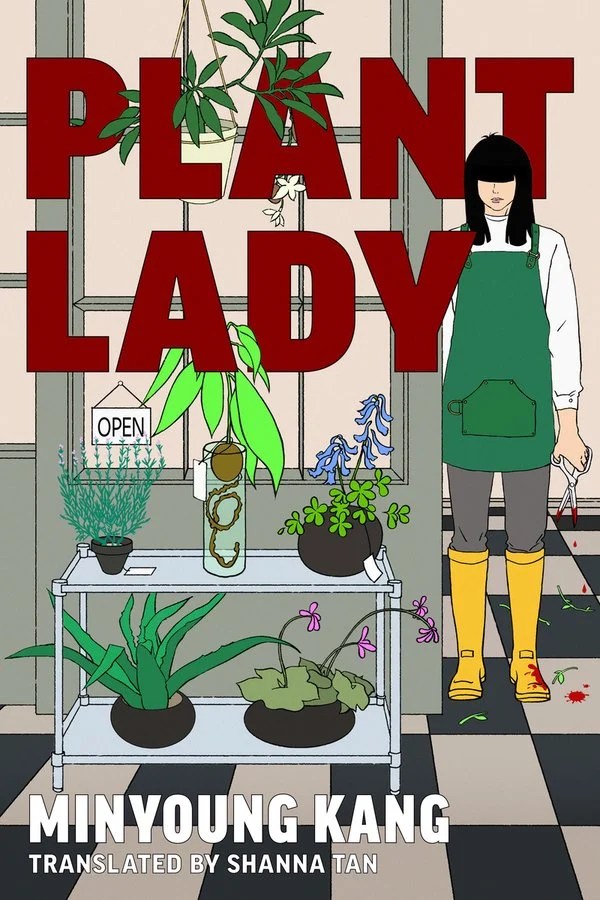
There’s a lot to love about Plant Lady, not least of which is the tempered delight the book takes with its kills. Though the prose, translated by Shanna Tan, feels restrained, there’s no subtlety in setting up the victims, nor in the various ways they’re dispatched to the great beyond. At just 120 pages long, the kills come quickly, and there’s little time for Yoohee to regret any of them. There’s a strong sense of Me Too-ism woven throughout, a sort of power fantasy granting revenge on those wronged in various ways by the patriarchy and those who benefit from it.
The lack of nuance to the murders, or how deserving each of the victims is, is a missed opportunity to craft a more complex story than clean-cut revenge. Each of the victims is painted clearly as a predator of some type or another, and each of their respective targets, the women, is strong but overpowered. The details change but the overall arc repeats itself without subversion. In an author’s note, Kang notes that Plant Lady started as a short story, and questions from (the male members of) her writing group about what the men had done to deserve being murdered prompted her to expand it into this novel.
In that sense, Plant Lady does justice to its short-story premise, though the concept alone wears a little thin after a few chapters. Some of my disappointment might be from cultural differences in expectations of plotting and prose. The fact that it is a short novel does, however, cover a multitude of sins, including having fun with a little light murder.

