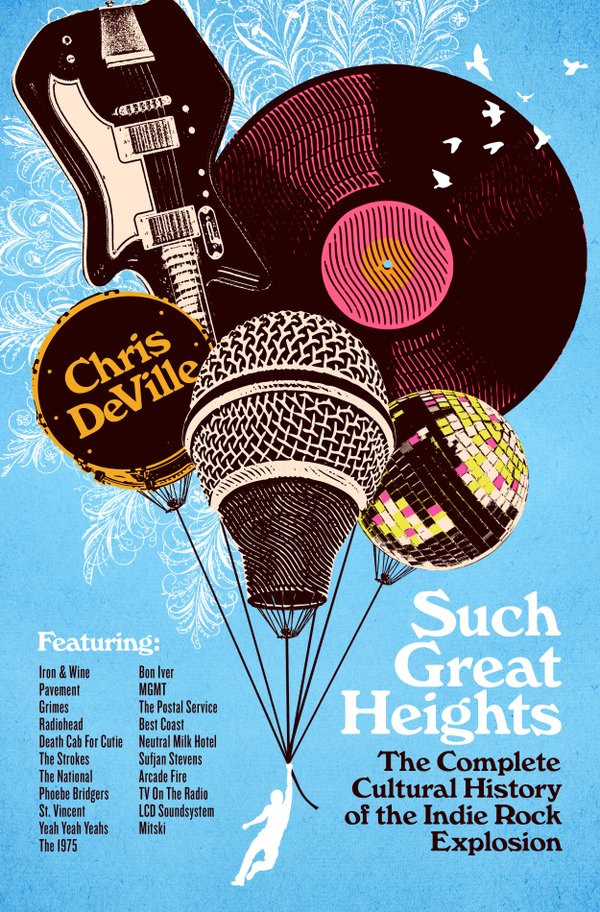
Thinking about where your music comes from is like thinking about how cheese is made, or makes cardboard boxes. It’s easy to feel like these things just appear. The lineage, and lingering influence, of the indie rock that colored millennial adolescence and young adulthood is traced in Chris DeVille’s fascinating Such Great Heights: The Complete Cultural History of the Indie Rock Explosion.
The 90s were a great time for a lot of music, but that hotbed of grunge and rap and pop also served as a fertile creche for what would become the many stripes of indie rock. As it slowly caught on among music enthusiasts, the first years of the new millennium gave it a giant shot in the arm in the form of teen dramas on the WB (later the CW). The lawlessness of the internet meant piracy could sail new seas, and that small bands could put their work out to a seemingly infinite audience without needing the weight of a large studio backing.
Meryl Streep’s monologue as Miranda Priestly in The Devil Wears Prada about the long line of unseen hands guiding our choices right into the bargain bin of sweaters is a classic for a reason, but it kept echoing in my mind as I read. Because for all the kismet the seemingly under-the-radar music acts of the 2000s and 2010s, it seems there’s always some type of curation. For anything to come to market and for anything to be visible (and, in those days, widely available), there had to be someone supporting and it in some way, and “support” does equal curation in some sense. Even for me, proudly rolling my eyes at shows like The OC while scouring early social media for the strange new sounds I was going to make into my personality until the next earworm came along, there sure were a lot of forces making sure I discovered those hidden gems.
Then again, that’s the way with any movement. Any given thing in front of us has been designed and influenced and curated by thousands of unseen hands, hands that operate without fully knowing all the other hands working alongside them. What’s interesting is to see how some of them have interplayed to create a movement that was both a product of and colored a specific time and place, and then went on to influence the sounds to define the time and place that followed. (If you’d like a continued look at this era, NPR Music did its own retrospective last year.)
True to the spirit of a music history, Such Great Heights also comes with a playlist, both as receipts and as a soundtrack to really feel the vibe as it shifts through the years. (Fear not, you don’t have to look each song up yourself: you should be able to search for it on the streaming platform of your choice.) Some of the songs are no-brainers, like Jet’s “Are You Gonna Be My Girl” or Iron and Wine’s cover of “Such Great Heights” (hey, that’s the title of this book). Others surprised me, such as Kelly Clarkson’s “Since U Been Gone” and Coldplay’s “Viva La Vida.” Even Carly Rae Jepsen finds her way onto one chapter’s soundtrack, just four tracks down from Vampire Weekend. I’ll admit I found myself reacting to the inclusion of some songs and feeling precious about others. There’s a pretentiousness that tends to flourish in any fandom, and indie rock is no exception.
For his part, DeVille, managing editor of Stereogum, is more pragmatic and open-minded than expected, although late in the book you do get a sense of what seems like oddly strong disdain for Mumford and Sons. This is indie rock, and that is also indie rock. This counts, and so does that. Don’t like such-and-such? No worries, your ironic mustache can soak up your tears. (Here, the disdain is mine.) The family tree of indie rock branches as wide and far as its roots in past musical and cultural movements. No musical or cultural history can ever be truly comprehensive, especially not in the internet age. But DeVille maps out this family tree warmly, bringing both clarity and obvious love to the genre, the people who made it, and the people who embraced it.

